Americana
1880 Cowboys Bull Fight, Nast, Revival of Falconry — Harper's Weekly — Nov 27
$45.45
-
Details📜 ABOUT THIS PIECE OF HISTORY 📜
The November 27, 1880 issue of Harper's Weekly is a richly varied post-election issue — W.A. Rogers delivers one of the most vivid and historically significant western illustrations of the entire 1880 run in his magnificent full-page scene of cowboys betting on a bull fight, Thomas Nast opens the issue with a front-page cartoon processing the political aftermath of Garfield's victory, the medieval sport of falconry makes a surprising and atmospheric half-page appearance, and a double-page centerfold of an artist's studio fills the center with the bohemian world of the Gilded Age art scene. This is an issue of exceptional visual variety and lasting historical interest.
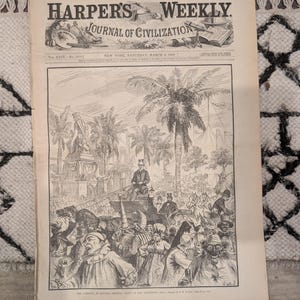
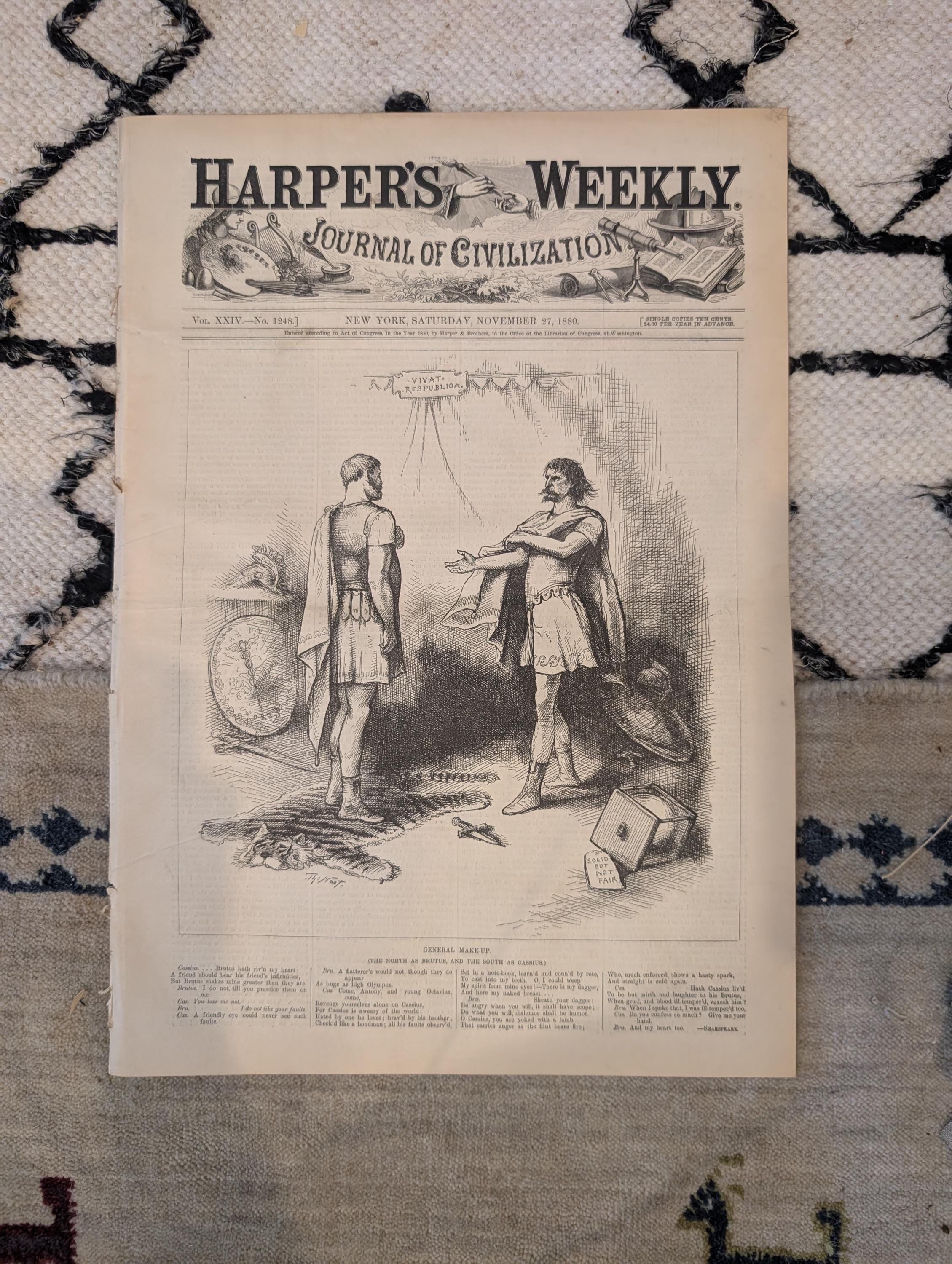
🎨 FULL FRONT PAGE — THOMAS NAST: "GENERAL MAKE-UP"
Thomas Nast opens the post-election issue with a front-page cartoon whose title — "General Make-Up" — works on multiple levels with characteristic precision. In the immediate aftermath of Garfield's victory, the great question before the Republican Party was the make-up of the incoming administration — who would fill the cabinet, what factions would be rewarded, how the competing wings of the party would be reconciled after the bitter convention battle between Grant, Blaine, and Garfield. The "general make-up" was also, in the theatrical slang of the era, the costume and disguise that a performer adopted before going on stage — raising the question of what the incoming Garfield administration would look like once its makeup was complete and the performance began. Nast's front pages in this post-election period were doing the essential work of political journalism — holding the victorious party accountable before it had even taken office, watching the patronage distribution and cabinet selection with the same skeptical eye he had trained on the Democrats all year. A fully displayable and historically significant front page for collectors of Nast's work and the post-election political history of 1880.
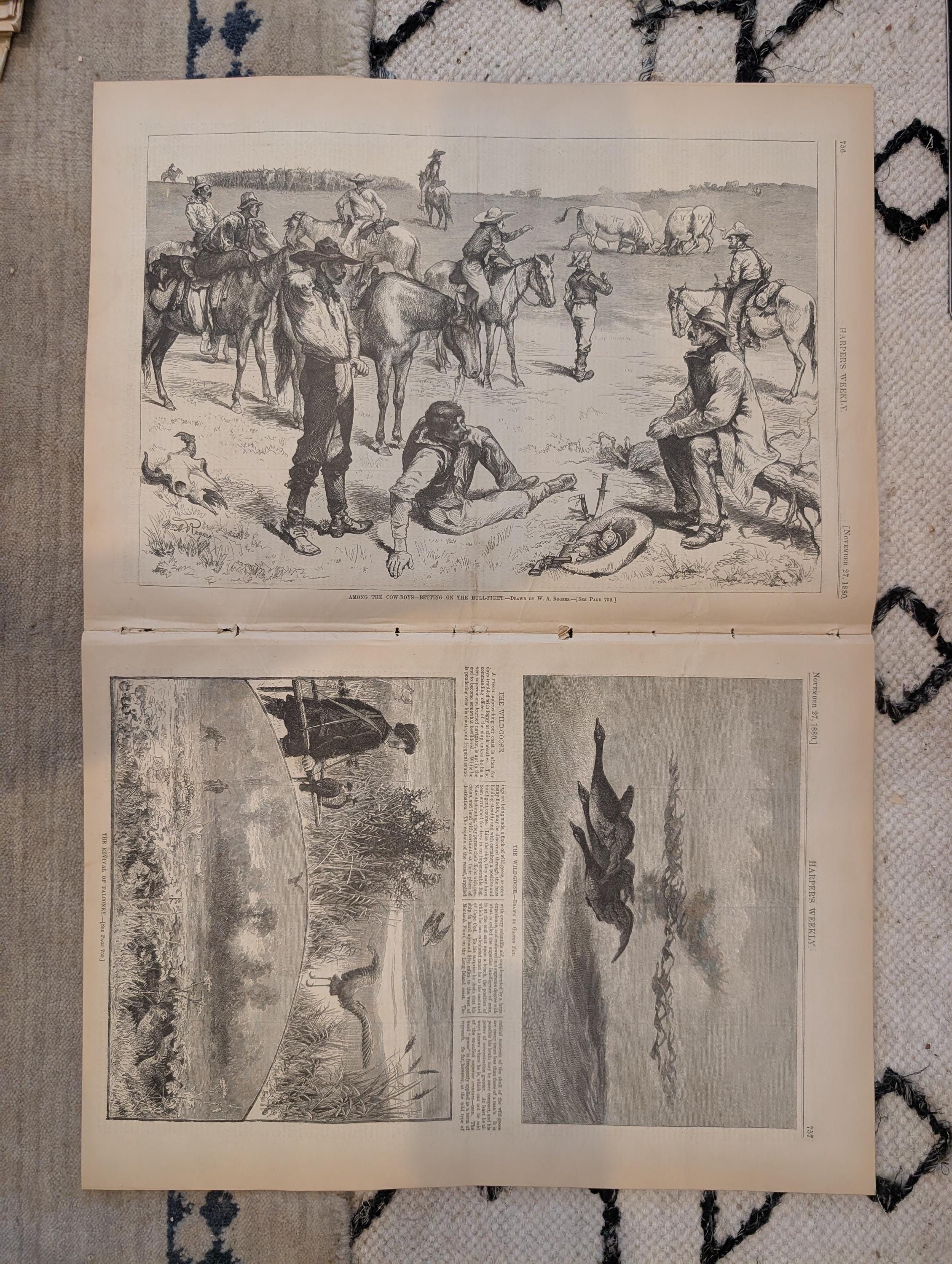
🤠 FULL PAGE — W.A. ROGERS: "AMONG THE COWBOYS — BETTING ON THE BULL FIGHT"
The visual crown jewel of this issue — and one of the most vivid, specific, and historically important western documentary illustrations in the entire Harper's Weekly run for 1880. W.A. Rogers's magnificent full-page scene of cowboys gathered to watch and bet on a bull fight is a primary source document of extraordinary rarity and historical complexity — capturing a specific aspect of western ranch culture that has largely vanished from the historical record and that Rogers documents here with the authenticity of direct observation and the artistry of one of the finest illustrators of the Gilded Age.
The bull fight depicted here is not the Spanish corrida — it is the rougher, more informal practice of setting two bulls against each other that was common on the ranches of Texas and the Southwest, where Spanish and Mexican ranching traditions blended with Anglo-American cowboy culture to produce a distinctly regional sporting practice. The cowboys gathered around the fighters — betting, watching, shouting, their horses and their working lives momentarily set aside for the pure spectacle of two powerful animals in contest — are rendered with the human specificity and documentary honesty that made Rogers's western illustrations among the finest of the era.
This is the open range at its most authentic — not the romanticized cowboy of later mythology but the working man of the actual West, with his actual diversions, his actual gambling, his actual mixture of Spanish and Anglo cultural inheritance, captured by an artist who was there. For collectors of cowboy history, western history, W.A. Rogers illustration, cattle culture history, and the documentary history of the American West, this full page is an irreplaceable primary source of exceptional importance and beauty.
🦅 HALF PAGE — "THE REVIVAL OF FALCONRY"
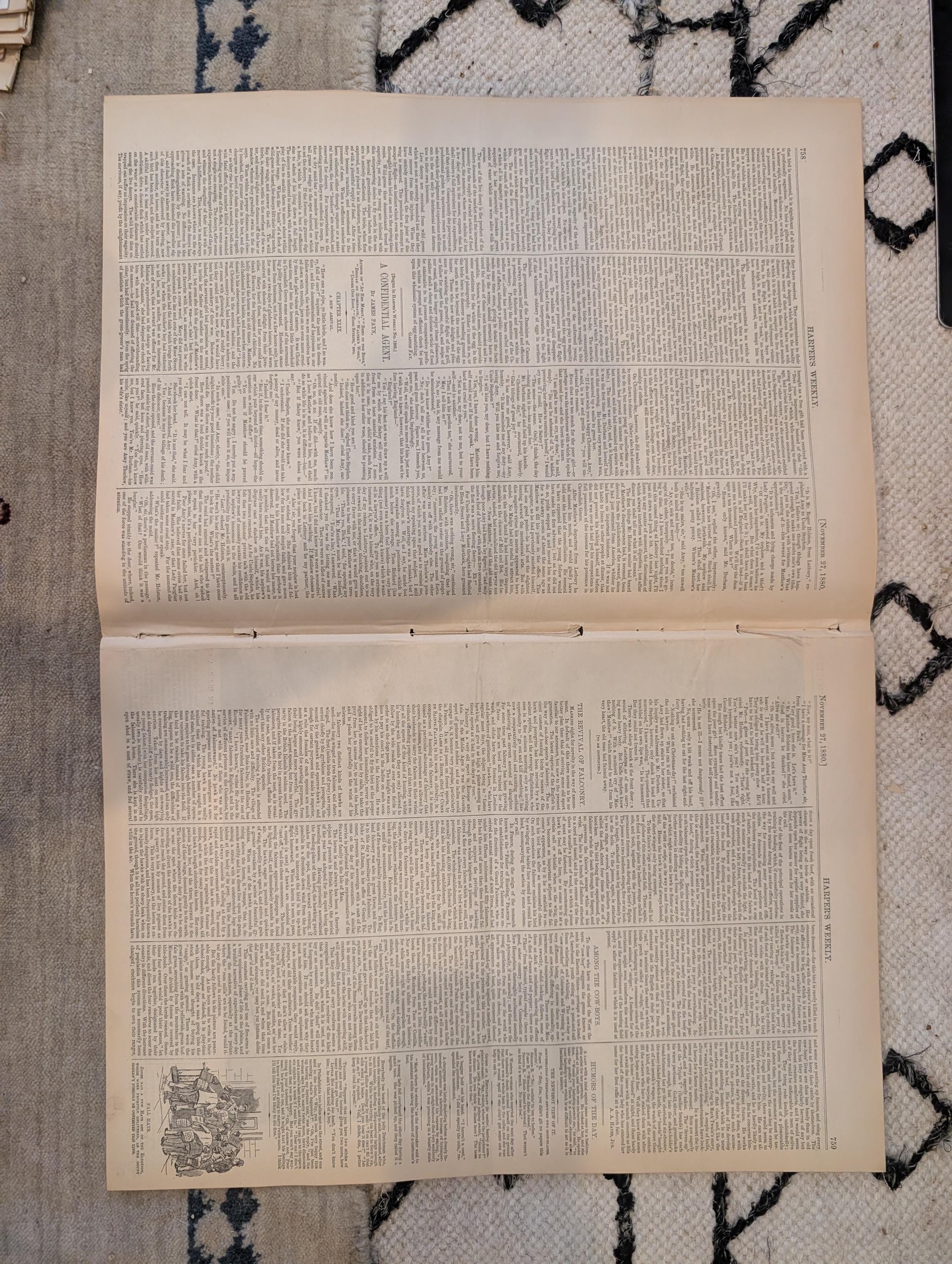
A fascinating and atmospherically distinctive half-page illustration documenting the Victorian revival of falconry — the ancient medieval art of training hawks and falcons to hunt that was experiencing a remarkable renaissance among the sporting aristocracy and wealthy gentry of Britain and America in the 1870s and 1880s. Falconry had been the sport of kings and nobles for a thousand years before the gun made it obsolete, and its Victorian revival was simultaneously a sporting practice and a cultural statement — a rejection of the purely mechanical pleasures of the breech-loader in favor of the ancient, demanding, intellectually complex partnership between human and raptor that the medieval world had elevated to an art form. The falconer with his hawk on his gloved fist, the hood and the bells and the lure — all the paraphernalia of a sport that had changed barely at all in a millennium — is rendered here with the atmospheric detail and historical consciousness that Harper's Weekly brought to its finest sporting illustration. A wonderful and distinctive piece for collectors of falconry history, Victorian sporting culture, and the history of field sports.
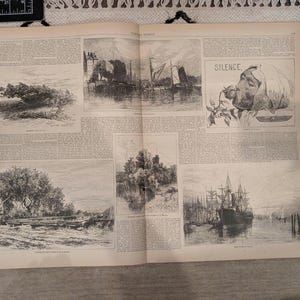
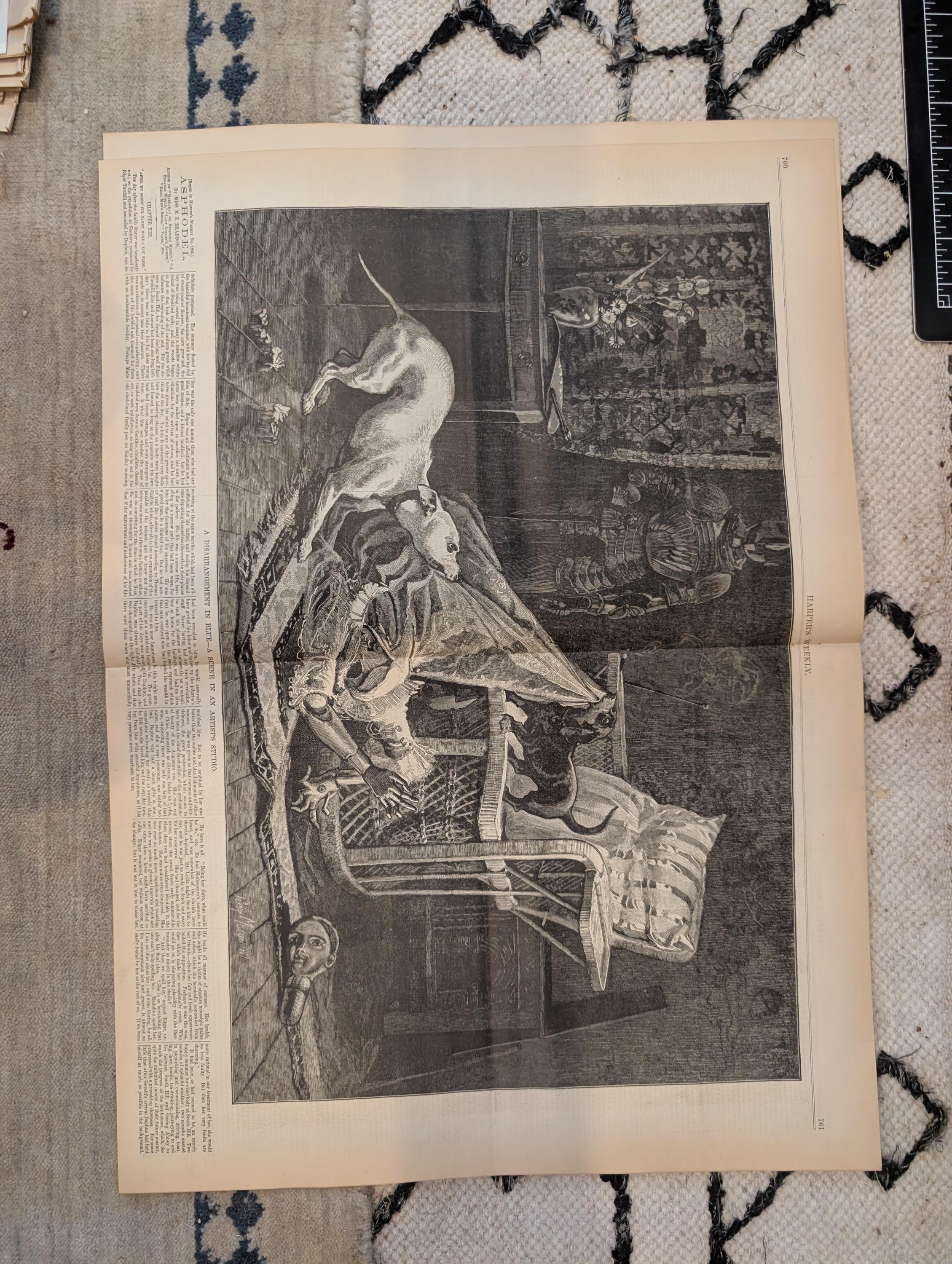
🎨 DOUBLE-PAGE CENTERFOLD — "A DISARRANGEMENT IN BLUE — A SCENE IN AN ARTIST'S STUDIO"
A magnificent double-page centerfold of an artist's studio in mid-catastrophe — "A Disarrangement in Blue" capturing the particular chaos of the Gilded Age artist's working space at a moment of comic disruption, the carefully arranged blue still-life or costumed model suddenly undone by some unnamed accident or intervention. The artist's studio was one of the great romantic and social spaces of the Victorian world — the place where bohemian life, aesthetic ambition, and the commerce of art production intersected in a setting that fascinated the general public and provided illustrators with one of their most beloved subjects. The "disarrangement" at the center of this centerfold gives the familiar studio scene a comic energy and narrative momentum that the standard studio illustration rarely achieved, the blue palette that dominates the composition giving the whole scene a painterly self-consciousness that reflects the aesthetic sophistication of Harper's Weekly's finest centerfold work. A charming and fully displayable centerfold for collectors of Victorian art world illustration and Gilded Age cultural history.
🔍 CONDITION & TRANSPARENCY 🔍
Completeness: Complete 16-page issue.
Authenticity: Guaranteed original printing from November 27, 1880 — not a reproduction.
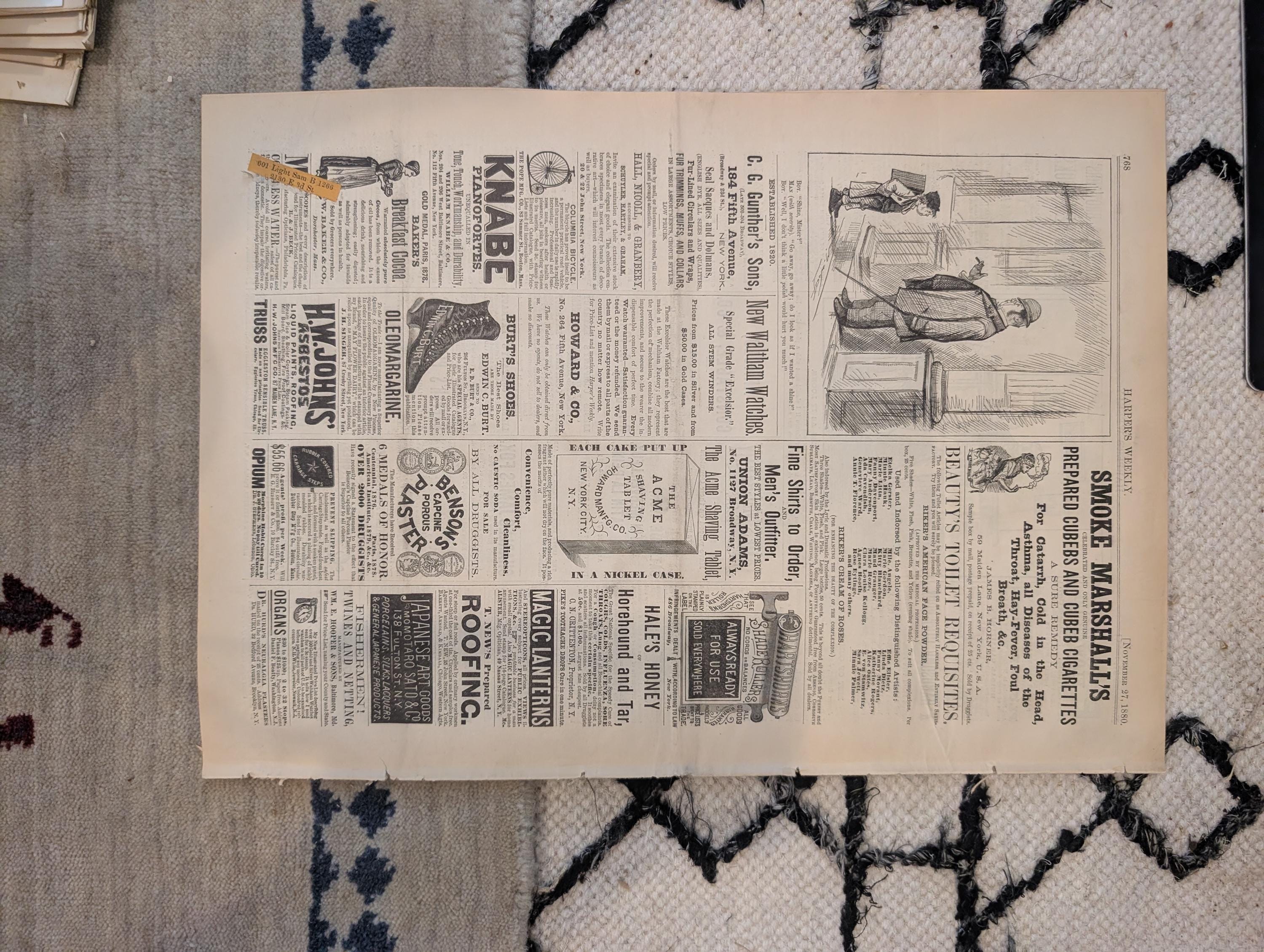
Condition Report: Presents well for its 145-year age with natural toning to the newsprint consistent with paper of this era. The Thomas Nast front page, the W.A. Rogers cowboys bull fight full page, the falconry half page, and the artist's studio double-page centerfold are all clear and displayable. I have photographed every page — please review all images carefully and don't hesitate to ask for additional close-ups of any area before purchasing.
📦 SHIPPING & PRESERVATION 📦
Housed in an acid-free archival folder with Mylar overlay to protect the 145-year-old newsprint
Flat-shipped with heavy-duty reinforcement to ensure safe arrival of the centerfold
Fully tracked for your peace of mind
In November 1880 W.A. Rogers was among the cowboys watching bulls fight on the open range, a Victorian gentleman was reviving the art of falconry, an artist's studio was in beautiful disarray, and Thomas Nast was already watching the incoming Garfield administration with his customary skeptical eye. What a paper. What a world.
🏷️ TAGS
1880 Cowboys Bull Fight WA Rogers, Among Cowboys Betting Bull Fight, WA Rogers Western Illustration, Revival of Falconry Victorian, Artist Studio Disarrangement Blue, Thomas Nast General Make Up, Open Range Cowboy Culture, Gilded Age Western Documentary, Cowboy History Primary Source, Falconry History Victorian, Texas Ranch Culture 1880, WA Rogers Harper's Weekly, Artist Studio Victorian, Antique Newspaper 1880, Harper's Weekly 1880, Gilded Age Western History -
Shipping & Policies
Related Products