Americana
1880 Harper's Weekly — Nast, Grant in Havana Carnival, Race Horses — Mar 6
$38.38
-
Details📜 ABOUT THIS PIECE OF HISTORY 📜
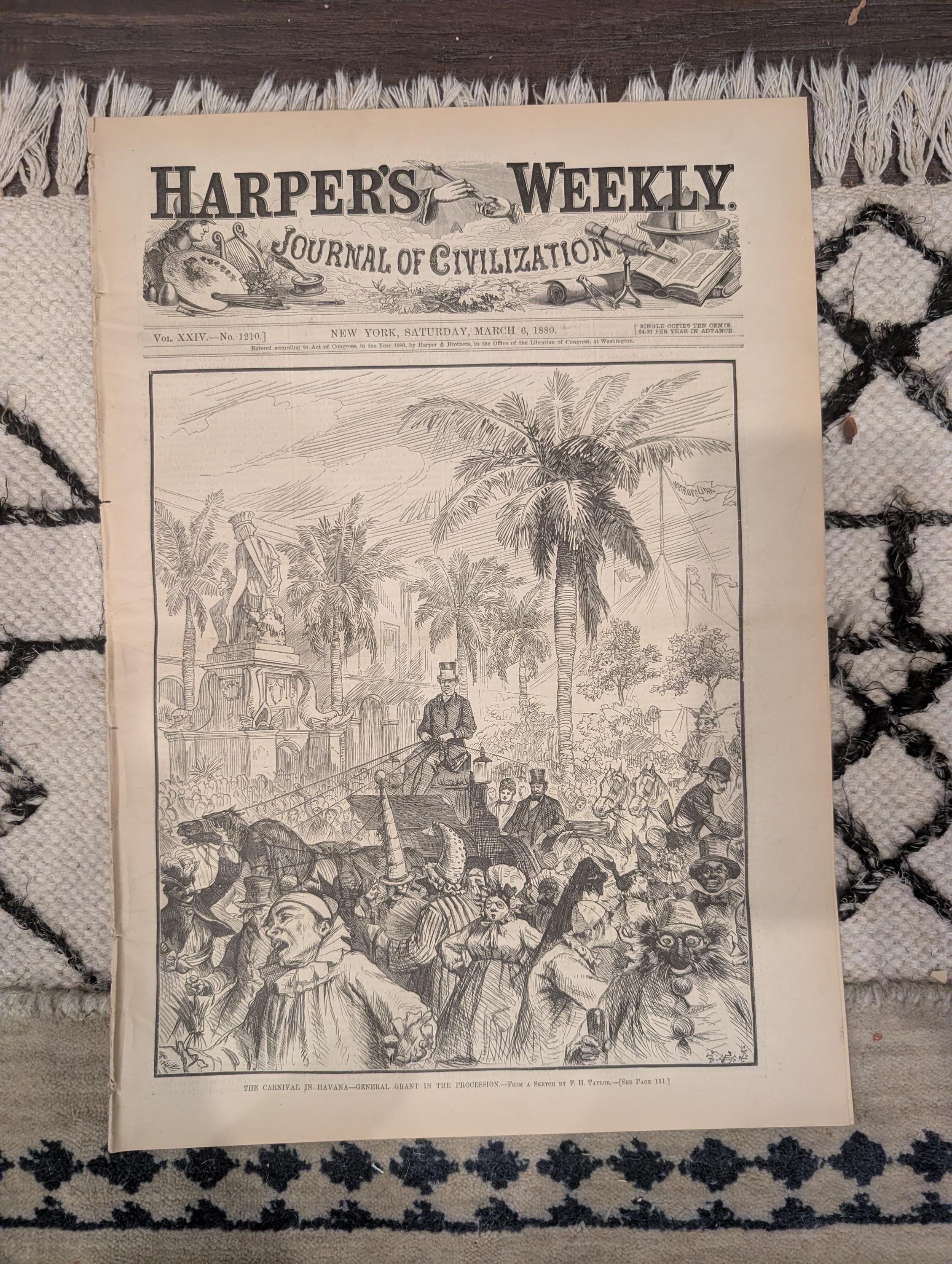
The March 6, 1880 issue of Harper's Weekly is a genuinely spectacular one — Grant leads a Havana carnival procession on the full front page, Thomas Nast delivers not one but two full-page political cartoons at the height of a presidential election year, the carnivals of Central America erupt in full-page color and chaos, American thoroughbreds are crossing the Atlantic to challenge English racing, and Ireland sends five more images of its suffering to an American public that cannot stop looking. This is one of the most visually and politically packed issues in the entire Harper's Weekly run for 1880.
🎭 FULL FRONT PAGE — "THE CARNIVAL IN HAVANA — GENERAL GRANT IN THE PROCESSION"
One of the most vivid and joyful front pages in the entire Grant tour series — and a genuinely extraordinary historical image. Ulysses S. Grant — former President, savior of the Union, the most celebrated American alive — riding through the streets of Havana at the height of the Cuban carnival, surrounded by the music, the costumes, the crowds, and the explosive color of one of the great festivals of the Caribbean world. This is a front page unlike almost any other in the Harper's Weekly run: American presidential history colliding with Cuban carnival culture in a scene of pure spectacle that no other illustrated newspaper of the era could have captured with such immediacy. A magnificent and fully displayable front page for collectors of Grant history, Cuban history, carnival culture history, and Gilded Age Americana.
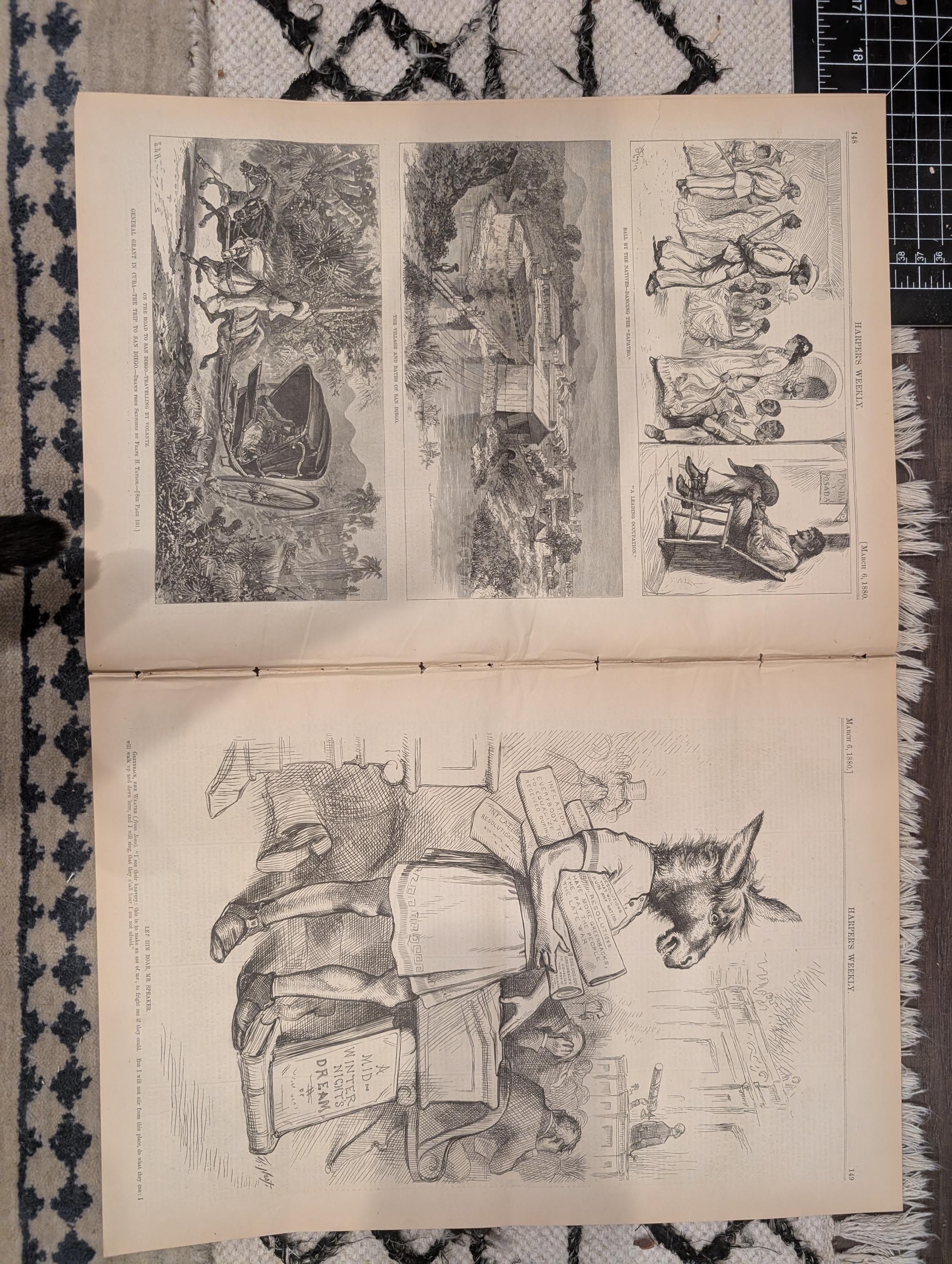
🌴 THREE ONE-THIRD PAGES — "GENERAL GRANT IN CUBA — THE TRIP TO SAN DIEGO"
Three additional illustrations extend the Grant Cuba coverage inland — documenting the former President's journey to San Diego de los Baños, the celebrated Cuban spa town whose thermal springs had been drawing the island's elite for generations. Grant moving through the Cuban countryside — the royal palms, the tobacco fields, the colonial architecture of a Spanish colony still raw from a decade of brutal civil war — is a richly layered historical image. Fine pieces for collectors of Grant history, Cuban history, and the history of American-Caribbean relations in the Gilded Age.
🎨 FULL PAGE — THOMAS NAST: "LET HIM ROAR, MR. SPEAKER"
Thomas Nast delivers the first of his two full-page political cartoons — "Let Him Roar, Mr. Speaker" — a pointed intervention in the congressional politics of the moment. 1880 was a presidential election year and the House of Representatives was a battleground of procedural warfare between Republicans and Democrats, with the speakership and the rules of debate at the center of constant conflict. Nast's title — with its theatrical contempt for a roaring political opponent — captures the mood of a man who had spent nearly two decades using his pen to separate genuine patriotism from political theater. A significant Nast full page for collectors of his work and of Gilded Age congressional history.
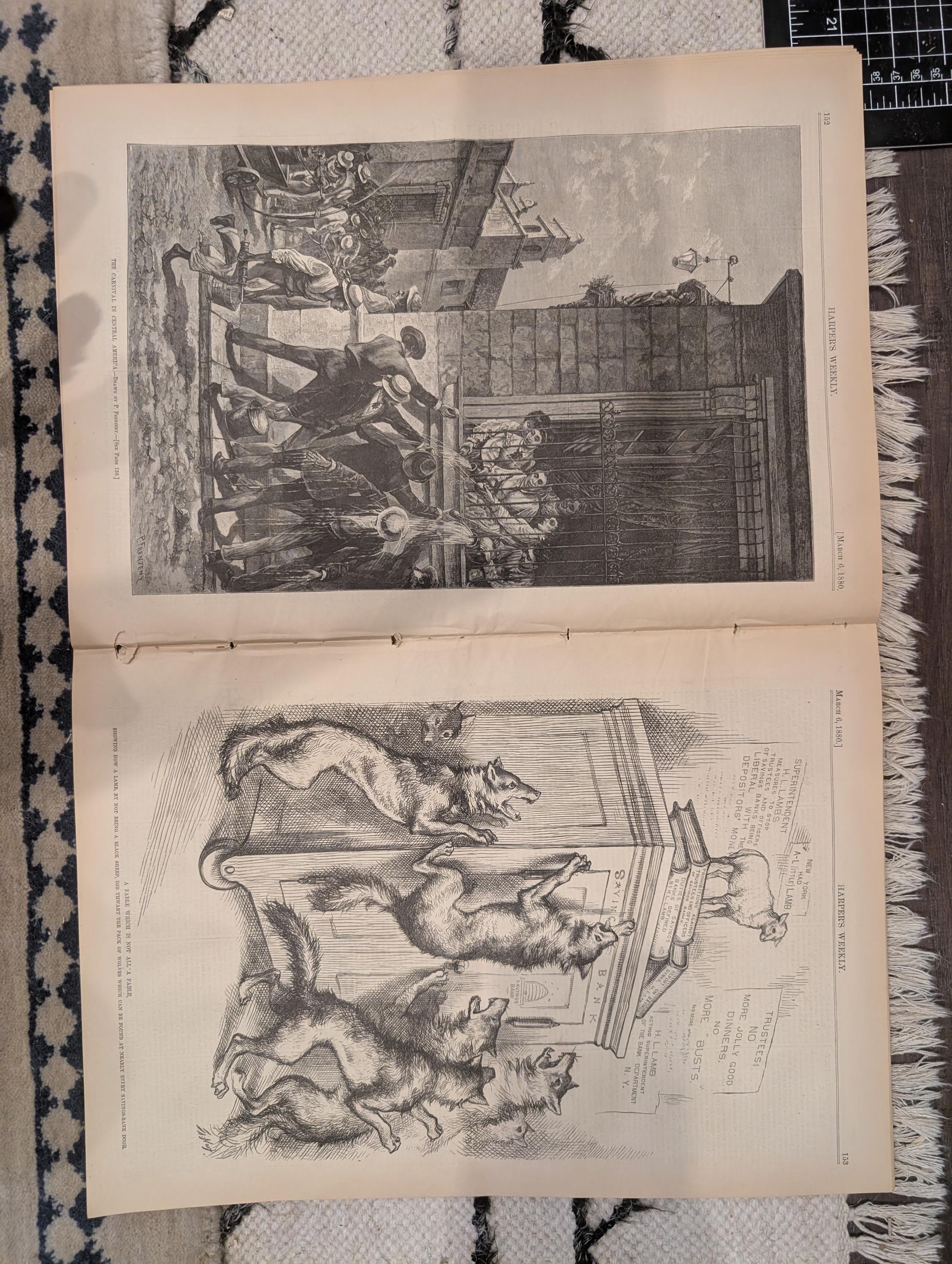
🎨 FULL PAGE — THOMAS NAST: "A FABLE WHICH IS NOT ALL A FABLE"
The second Thomas Nast full-page illustration of the issue — and the title alone signals that this one cuts deeper. "A Fable Which Is Not All A Fable" is Nast working in his most allegorical mode — the fable format allowing him to say things about American political life that direct caricature could not quite reach. In the 1880 election year context, with the question of a third Grant term actively being debated within the Republican Party and the legacy of Reconstruction hanging over every political calculation, Nast's fables carried particular weight. Two Thomas Nast full-page illustrations in a single issue is always an exceptional find for collectors of his work — this one delivers both his satirical directness and his more meditative allegorical depth in the same purchase.
🎪 FULL PAGE — "THE CARNIVAL IN CENTRAL AMERICA"
A magnificent full-page illustration of carnival celebrations in Central America — one of the most visually exuberant pages in this entire run of issues. The carnivals of Latin America were among the great spectacles of the Victorian world, and Harper's Weekly's coverage of them brought their color, energy, and cultural richness to American readers who had no other visual access to these celebrations. Coming in the same issue as the Havana carnival front page, this Central American full page makes March 6, 1880 one of the great carnival documents in the entire Harper's Weekly archive — a visual feast of masks, processions, music, and the joyful dissolution of ordinary life into festival. A wonderful and fully displayable piece for collectors of Latin American cultural history and Victorian illustrated travel journalism.
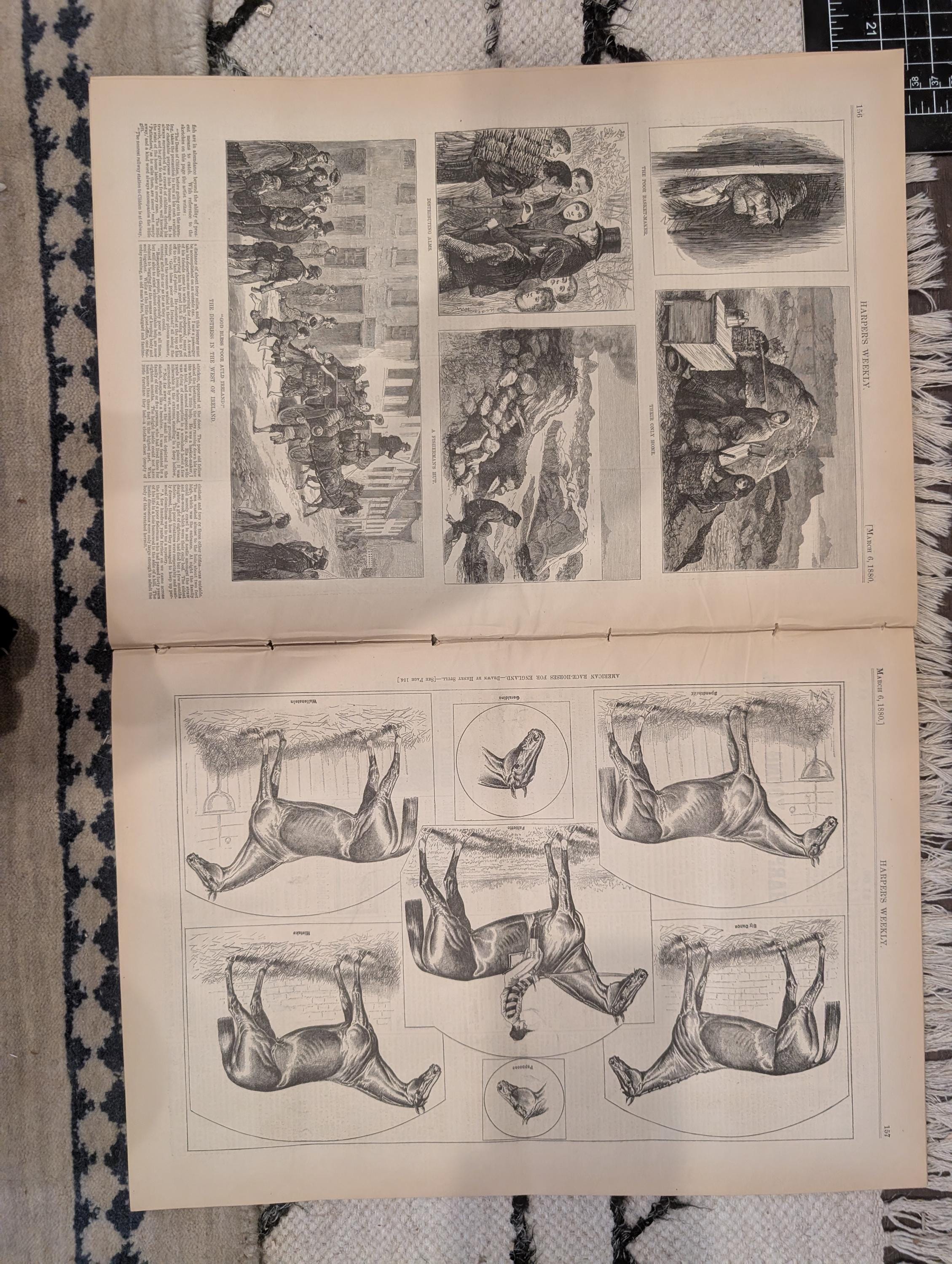
🐎 FULL PAGE — "AMERICAN RACE HORSES FOR ENGLAND"
A splendid full-page illustration documenting one of the great sporting stories of 1880 — the export of American thoroughbreds to England to compete on the tracks that had defined racing civilization for two centuries. American horse racing was in a period of extraordinary confidence and ambition in the Gilded Age, and the decision to send American horses to challenge English thoroughbreds on their home turf was a declaration of sporting nationalism that thrilled the American public. The horses depicted here — their conformation, their handlers, the whole apparatus of the thoroughbred trade — make this a superb piece for collectors of horse racing history, American sporting history, and Gilded Age Americana.
☘️ TWO-THIRDS PAGE — FIVE ILLUSTRATIONS: "THE DISTRESS IN THE WEST OF IRELAND"
Five illustrations in a two-thirds page — the most concentrated single dose of Irish famine documentary in this entire sustained run of Harper's Weekly coverage. Week after week through February and March of 1880 the paper had been bringing the reality of the Irish crisis to American readers with increasing specificity and emotional power, and this five-scene spread represents the cumulative force of that project at its most intense. The west of Ireland — Connemara, Mayo, the Atlantic coast — rendered in five views that together constitute a documentary portrait of a society under catastrophic stress. An essential primary source for collectors of Irish famine history, the Land League era, and Victorian humanitarian journalism.
🔍 CONDITION & TRANSPARENCY 🔍
Completeness: Complete 16-page issue.
Authenticity: Guaranteed original printing from March 6, 1880 — not a reproduction.
Condition Report: Presents well for its 145-year age with natural toning to the newsprint consistent with paper of this era. The Havana carnival front page, both Thomas Nast full pages, the Central America carnival full page, the American race horses full page, the Grant Cuba illustrations, and the Ireland distress five-scene spread are all clear and displayable. I have photographed every page — please review all images carefully and don't hesitate to ask for additional close-ups of any area before purchasing.
📦 SHIPPING & PRESERVATION 📦
Housed in an acid-free archival folder with Mylar overlay to protect the 145-year-old newsprint
Flat-shipped with heavy-duty reinforcement to ensure safe arrival
Fully tracked for your peace of mind
Grant leading a carnival procession through Havana, two Thomas Nast cartoons aimed at the heart of American politics, thoroughbreds crossing the Atlantic to challenge English racing, and five images of Irish suffering that wouldn't let the American public look away. March 1880 — what a week, what a paper.
🏷️ TAGS
1880 Harpers Weekly, General Grant Havana Carnival, Thomas Nast Political Cartoon, Nast Let Him Roar, Nast Fable Not All Fable, Carnival Central America, American Race Horses England, Grant Cuba Trip San Diego, Irish Famine West of Ireland, Gilded Age Horse Racing, Grant World Tour 1880, Presidential Election Year Nast, Cuban Carnival History, Irish Famine Primary Source, Antique Newspaper 1880, Harper's Weekly 1880 -
Shipping & Policies
Related Products