Americana
1880 Harper's Weekly — Nast, Grant in Mexico, Nordenskjold, Horse Abuse — Mar 27
$38.83
-
Details📜 ABOUT THIS PIECE OF HISTORY 📜
The March 27, 1880 issue of Harper's Weekly is one of the most internationally sweeping issues of the entire year — Grant arrives at Vera Cruz in a six-scene full-page spectacular, a polar explorer is being fêted in Naples after one of the great voyages in the history of human navigation, Thomas Nast fires off a front-page political cannon, horses are being abused on the streets of American cities and Harper's intends to say so, and famine has come to Silesia. From the docks of Mexico to the salons of Naples to the frozen fields of Prussia, this is Harper's Weekly at its most globally engaged — and at its most morally serious.
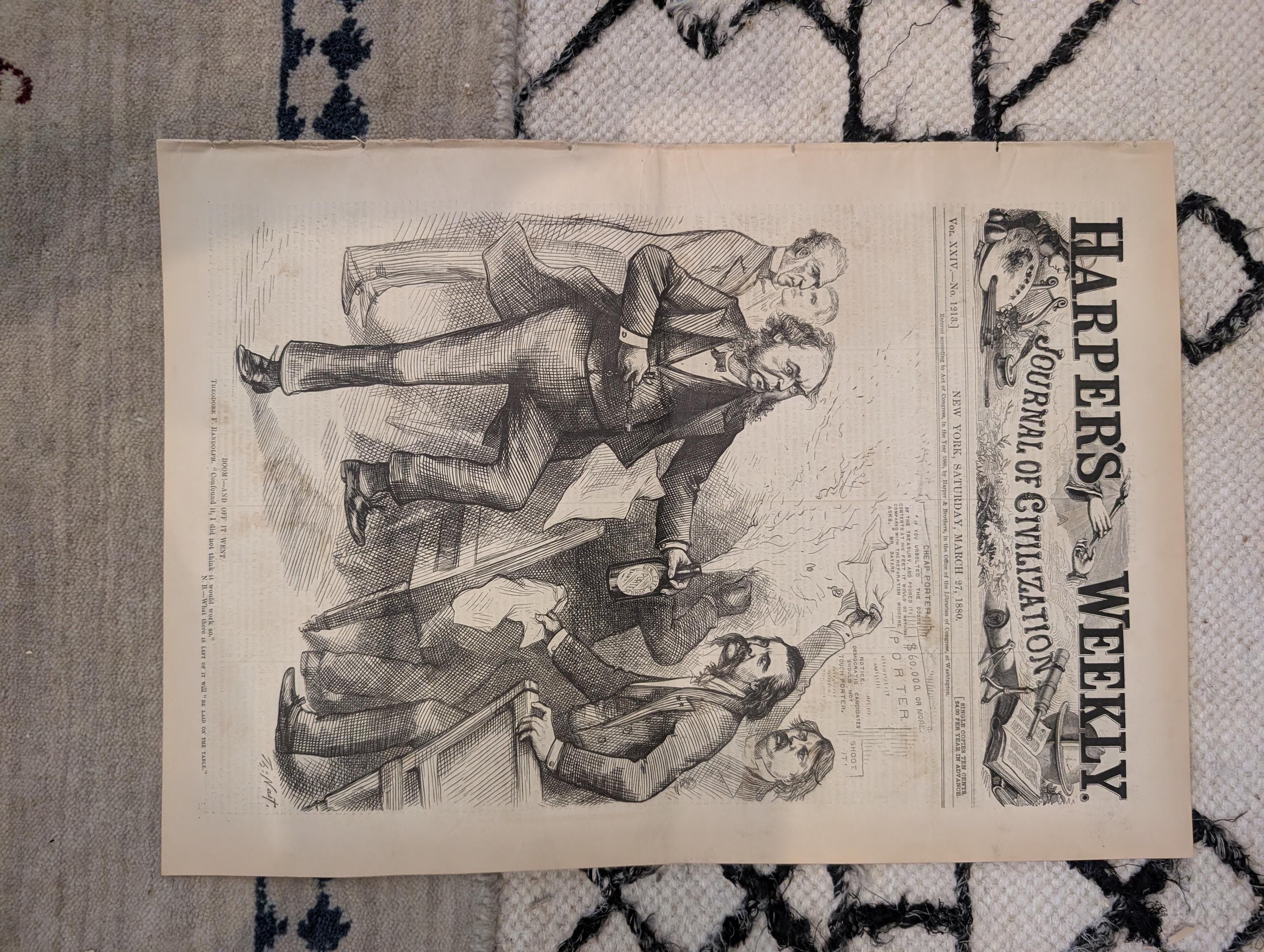
🎨 FULL FRONT PAGE — THOMAS NAST: "BOOM! — AND OFF IT WENT"
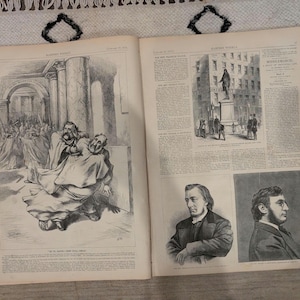
Thomas Nast opens the issue with characteristic explosive energy — "Boom! — And Off It Went" is the kind of title that tells you everything and nothing at once, which is exactly how Nast liked it. In the spring of 1880, with the Republican national convention approaching and the third-term Grant movement building toward its climax, the political landscape was a field of live ammunition — careers being made and destroyed, alliances forming and fracturing, the whole machinery of American presidential politics grinding toward its quadrennial explosion. Nast's "Boom!" captures that moment of maximum political tension with the wit and draftsmanship that had made him the most feared and celebrated political cartoonist in America. A fully displayable and historically rich front page for collectors of Nast's work and Gilded Age presidential election history.
🌊 FULL PAGE — "GRANT'S VISIT TO MEXICO — THE ARRIVAL AT VERA CRUZ" — SIX SCENES
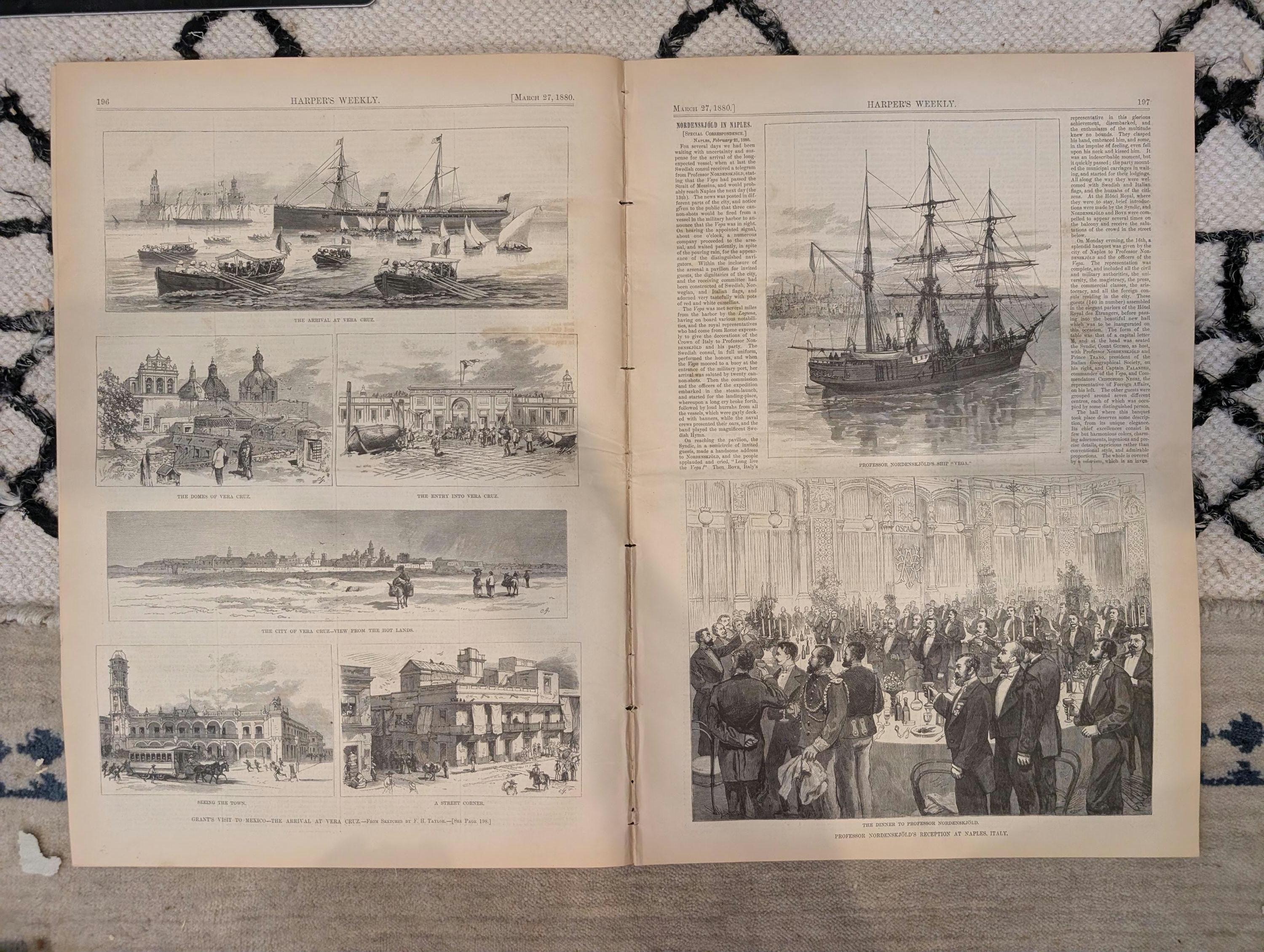
The crown jewel of this issue for Grant collectors and historians of American-Mexican relations — a magnificent six-scene full-page illustration documenting Ulysses S. Grant's arrival at Vera Cruz, Mexico, as his extraordinary post-presidential world tour reached its final and most politically significant destination. Grant in Mexico was not merely a courtesy visit — it was a geopolitical event of the first importance. Mexico under President Porfirio Díaz was in the early years of the transformation that would make it one of the great destinations for American investment capital, and Grant was deeply involved in schemes to develop Mexican railroads and mining interests that would eventually consume much of his post-presidential attention and fortune. The reception at Vera Cruz — one of the great ports of the Americas, rich with the history of Spanish conquest and American intervention — was spectacular, and these six scenes capture its full human and ceremonial reality. For collectors of Grant history, Mexican history, and the history of American-Mexican relations in the Gilded Age, this full page is an essential primary source document.
🧭 HALF PAGE & QUARTER PAGE — "PROFESSOR NORDENSKJÖLD'S RECEPTION AT NAPLES, ITALY"
Two illustrations documenting one of the great celebrations of scientific heroism in the Victorian world — the reception at Naples of Adolf Erik Nordenskjöld, the Swedish-Finnish explorer who had just completed the first successful navigation of the Northeast Passage, sailing from the Atlantic to the Pacific along the Arctic coast of Eurasia in his ship the Vega. Nordenskjöld's achievement — accomplished in 1878-1879 after centuries of failed attempts by the greatest navigators in history — had electrified the scientific world and the public imagination alike, and his triumphal progress through the capitals of Europe was one of the great celebrity tours of the age. The Naples reception, with its Mediterranean warmth and Italian theatrical flair, was among the most festive stops on that tour. A wonderful piece for collectors of Arctic exploration history, the history of navigation, and Victorian scientific celebrity.
🚢 FULL PAGE — "CLEARING THE TRACK — ON BANKS IN A FOG"
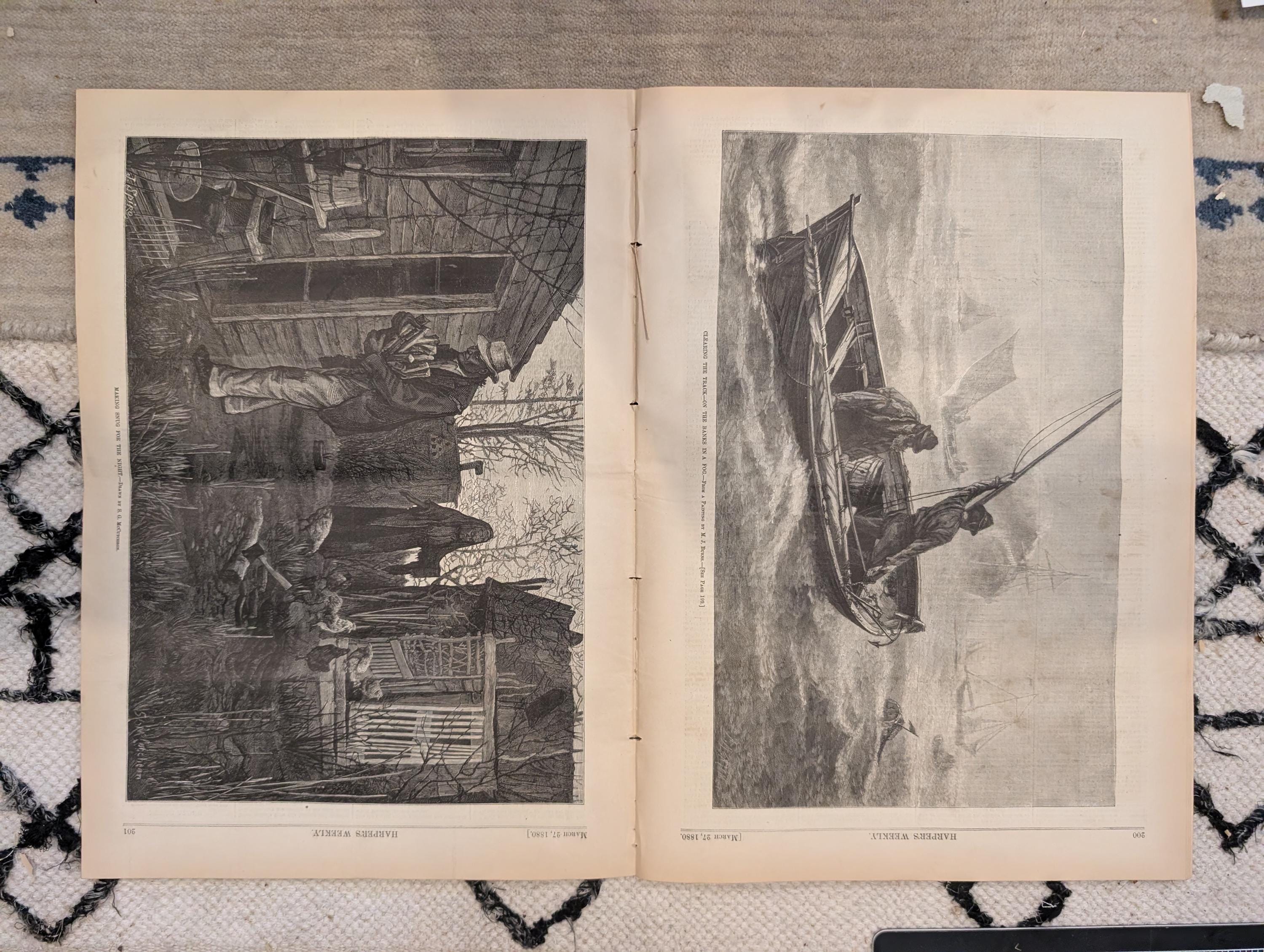
A dramatic full-page illustration of maritime navigation under the most treacherous conditions — ships working through the fog-shrouded Banks of Newfoundland, where the cold Labrador Current meets the warm Gulf Stream to produce some of the densest and most dangerous fog in the North Atlantic. The Grand Banks were the great fishing grounds of the Western world, and the fog that so often shrouded them was a constant and deadly hazard for the hundreds of vessels working those waters at any given time. A vivid piece of maritime documentary illustration for collectors of nautical history and Victorian seafaring.
🌙 FULL PAGE — "MAKING SNUG FOR THE NIGHT"
A companion piece of maritime illustration — the domestic and human side of life at sea, the end-of-day rituals of a vessel preparing for the night watch with all the practiced efficiency of sailors who have done it a thousand times. Where "Clearing the Track" captures the drama and danger of maritime life, "Making Snug for the Night" captures its quieter rhythms — the seamanship and camaraderie that sustained men through months at sea. Together these two full-page maritime illustrations make this issue a particularly rich document for collectors of Victorian nautical art and seafaring history.
🐴 FULL PAGE — "HOW HORSES ARE ABUSED"
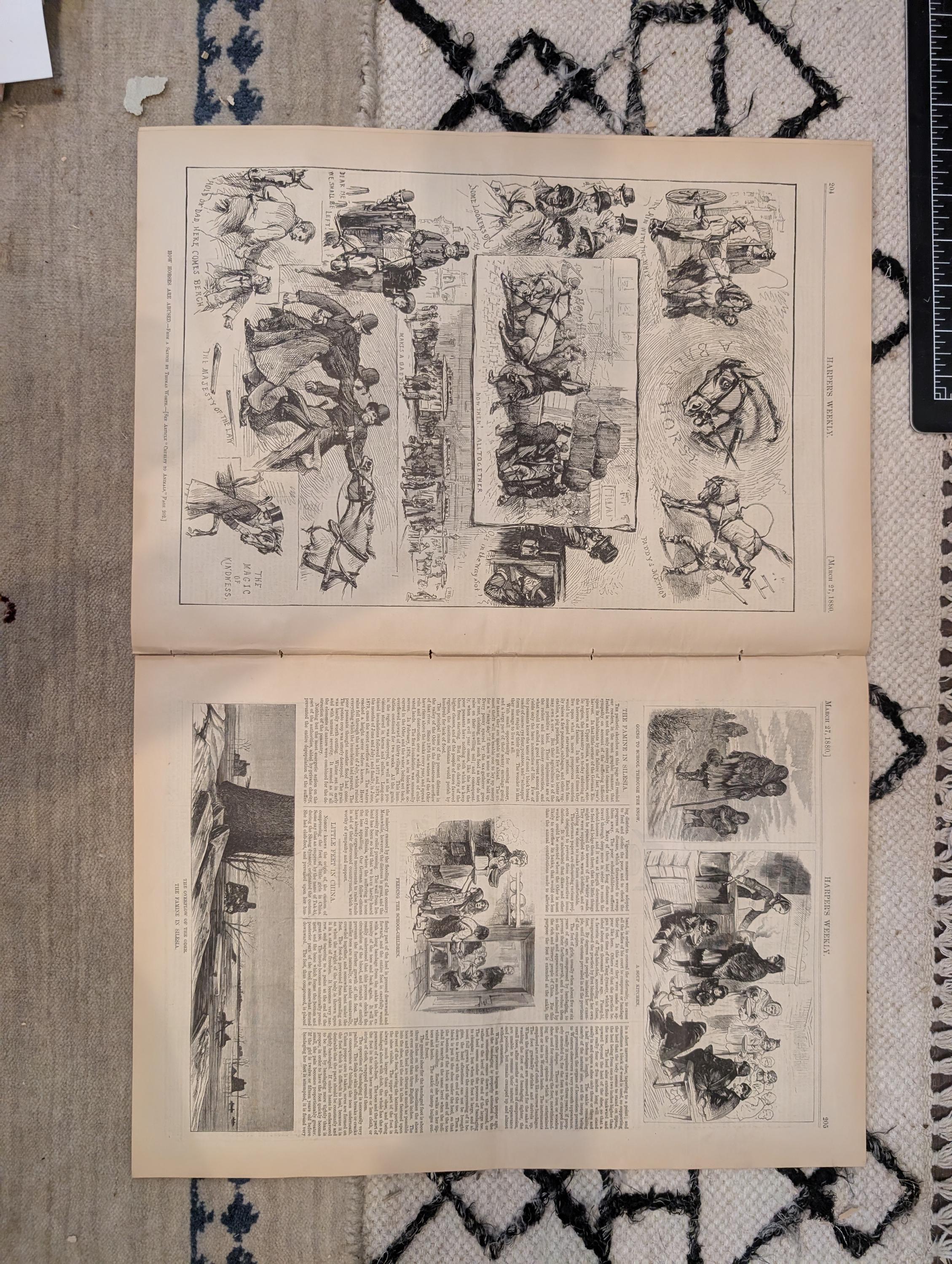
One of the most pointed and socially engaged illustrations in this issue — a full-page documentary of the abuse of horses in American cities, at a moment when the animal welfare movement was gathering significant public momentum. The working horses of Gilded Age cities endured conditions of extraordinary hardship — overloading, overworking, inadequate feeding, brutal driving, and the simple cruelty of men who regarded animals as tools rather than living creatures. Henry Bergh had founded the American Society for the Prevention of Cruelty to Animals in 1866, and by 1880 the ASPCA and its sister organizations were engaged in active enforcement and public education campaigns across the country. Harper's Weekly's full-page documentation of horse abuse was both a piece of social journalism and a contribution to that campaign — using the power of illustration to make visible what most city dwellers had learned not to see. A significant piece for collectors of animal welfare history, urban history, and Victorian social reform.
🌾 SMALL ILLUSTRATIONS — "THE FAMINE IN SILESIA"
Several small illustrations document the famine that was afflicting Silesia — the industrially rich but agriculturally vulnerable region of Prussia — bringing Harper's Weekly's sustained coverage of European famine conditions from Ireland to Central Europe. Silesian famine in the shadow of Prussian industrial wealth was a story with sharp political and social edges, and Harper's Weekly's willingness to document it reflects the paper's genuine global humanitarian consciousness. A fine additional piece for collectors of European history and Victorian humanitarian journalism.
🔍 CONDITION & TRANSPARENCY 🔍
Completeness: Complete 16-page issue.
Authenticity: Guaranteed original printing from March 27, 1880 — not a reproduction.
Condition Report: Presents well for its 145-year age with natural toning to the newsprint consistent with paper of this era. The Thomas Nast front page, the Grant at Vera Cruz six-scene full page, the Nordenskjöld illustrations, the maritime full pages, the horse abuse full page, and the Silesian famine illustrations are all clear and displayable. I have photographed every page — please review all images carefully and don't hesitate to ask for additional close-ups of any area before purchasing.
📦 SHIPPING & PRESERVATION 📦
Housed in an acid-free archival folder with Mylar overlay to protect the 145-year-old newsprint
Flat-shipped with heavy-duty reinforcement to ensure safe arrival
Fully tracked for your peace of mind
In March 1880 Grant was stepping ashore at Vera Cruz, a polar explorer was being celebrated in Naples, horses were being abused in American cities, and Thomas Nast was loading his cannon. Harper's Weekly held the whole world in sixteen pages.
🏷️ TAGS
1880 Harpers Weekly, Grant Visit Mexico Vera Cruz, General Grant Mexico 1880, Thomas Nast Political Cartoon, Nordenskjold Northeast Passage, Nordenskjold Naples Reception, Arctic Exploration History, Horse Abuse Victorian America, ASPCA History Animal Welfare, Grand Banks Fog Maritime, Making Snug for the Night, Famine in Silesia Prussia, Grant World Tour Mexico, American Mexican Relations 1880, Antique Newspaper 1880, Harper's Weekly 1880 -
Shipping & Policies
Related Products