
Americana
1862 Brooklyn Daily Eagle — Judge Lynch's Mercy, From Old Point, Jan. 27
$44.44
-
Details📜 ABOUT THIS PIECE OF HISTORY 📜
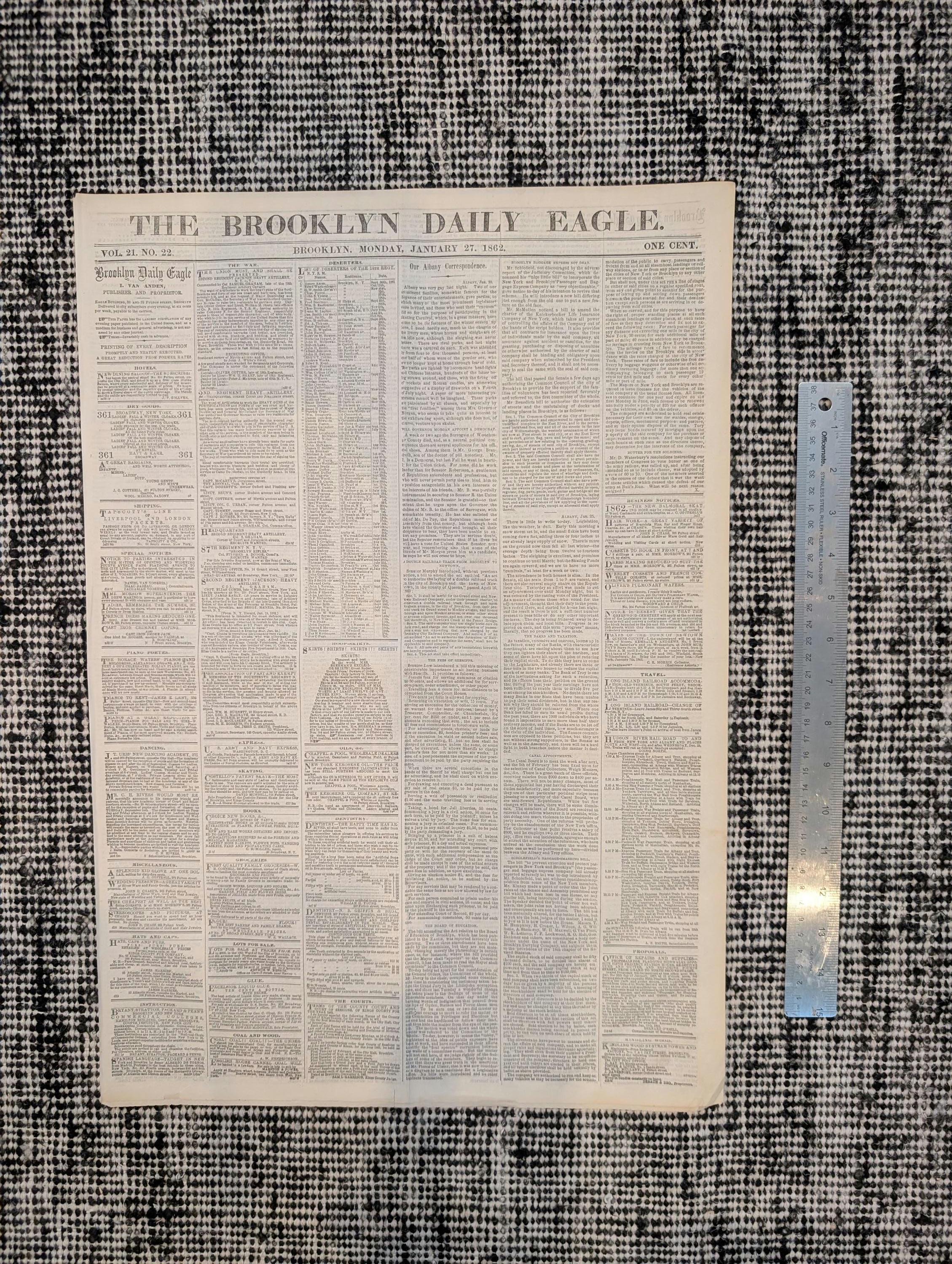
This January 27, 1862 issue of The Brooklyn Daily Eagle — Vol. 21, No. 22, a Monday — arrives ten days before Grant takes Fort Henry and changes the war. Brooklyn is deep in the anxious winter of 1861–62: the Army of the Potomac has been camped outside Washington for months, Lincoln is furious at McClellan's inaction, and the Eagle is publishing a serial fiction piece titled "Judge Lynch's Mercy." That title alone tells you something about the cultural temperature of Civil War Brooklyn — how close the surface of ordinary life ran to the era's darkest currents.
This copy is in excellent condition, with bright, sharp printing throughout.
---
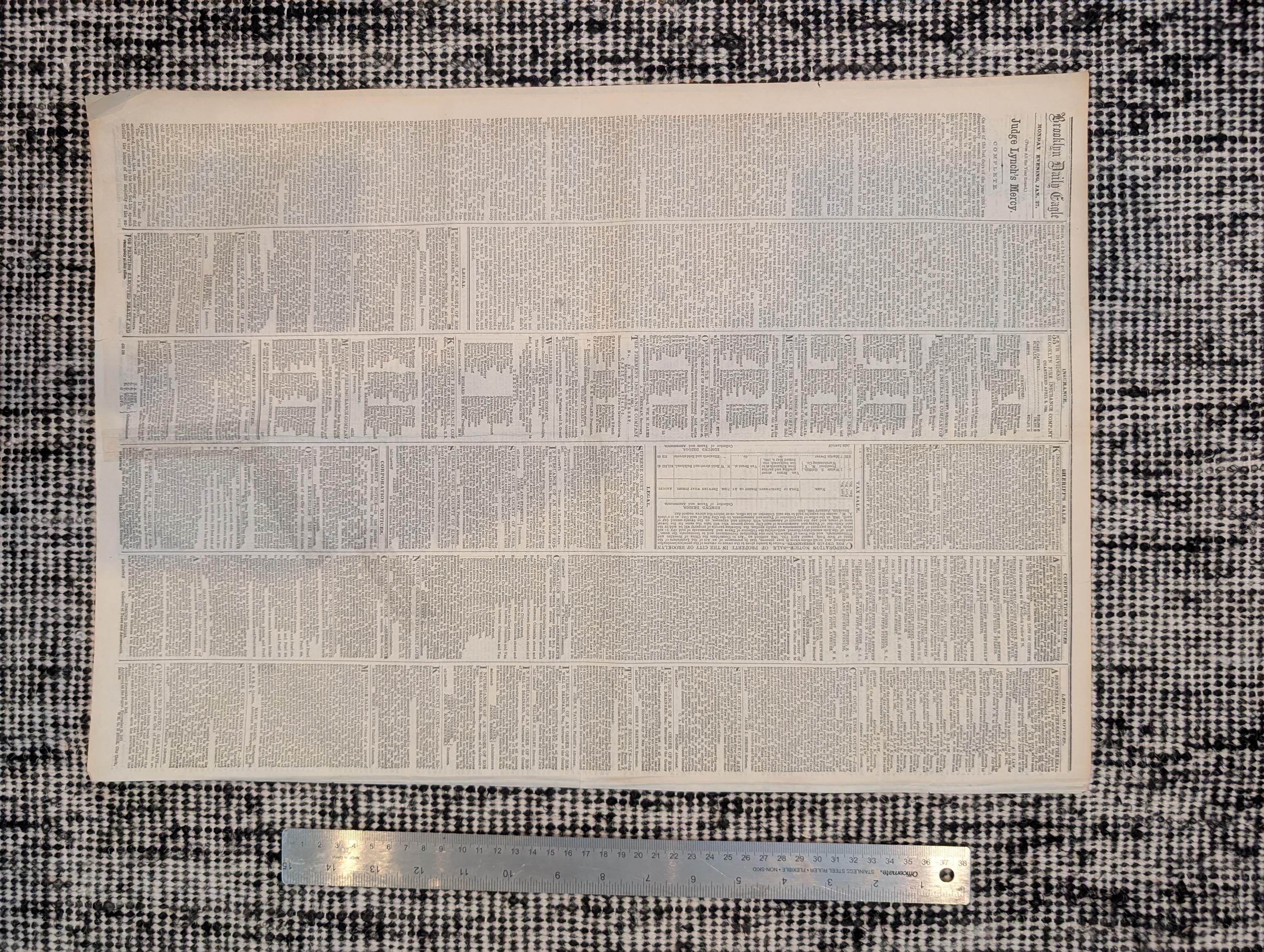
⚖️ "JUDGE LYNCH'S MERCY" — THE EVENING SERIAL 🎭
The back page, dated "Monday Evening, Jan. 27," opens with the serialized story **"Judge Lynch's Mercy"** — a Victorian fiction piece whose title carries enormous weight in January 1862. "Judge Lynch" was the widely understood euphemism for mob justice, for vigilante violence carried out without law or court — the extrajudicial killings that were already being reported from the South and West, and that would become one of the defining horrors of American history. A serial story titled "Judge Lynch's Mercy," published in a Brooklyn daily in the middle of the Civil War, places the reader directly at the intersection of Victorian popular fiction and the rawest moral questions of the era.
Whether the story itself is a frontier adventure, a Southern gothic, or something else entirely, its title is a document of how casually the Victorian press engaged with violence as entertainment — and how that entertainment existed in the same pages as casualty notices from the front.
---
⚓ FIRST EDITION — "FROM OLD POINT" ⚓
The inner pages carry a First Edition breaking news insert with dispatches "From Old Point" — Old Point Comfort at the tip of the Virginia Peninsula, the location of Fort Monroe, one of the most historically consequential Union military positions of the entire Civil War.
Fort Monroe never fell to Confederate forces throughout the war. It was from here that General Benjamin Butler issued his famous "contraband" ruling in May 1861, declaring escaped enslaved people who reached Union lines to be "contraband of war" — a ruling that effectively began the process of emancipation and transformed the war's moral character. By January 1862, Fort Monroe was a staging ground for planned Union operations along the Virginia coast, and dispatches "From Old Point" carried military intelligence about the Eastern Theater's next moves. What the Eagle's readers read in this First Edition insert was news from a place that was quietly rewriting American history.
---
🎓 "THE LECTURE SEASON" — BROOKLYN'S INTELLECTUAL LIFE IN WARTIME 🎓
The inner pages carry "The Lecture Season" column — the Eagle's coverage of Brooklyn's public lecture circuit, the era's dominant form of mass intellectual engagement. In January 1862, the lecture circuit was in full swing despite the war: lyceum halls across Brooklyn and New York were hosting speakers on topics from natural philosophy to political economy to the war itself. Lecturers of the era included figures of the stature of Frederick Douglass, Ralph Waldo Emerson, and the young Mark Twain — and the Brooklyn audience was one of the most sought-after on the circuit.
That the Eagle maintained a dedicated "Lecture Season" column through the winter of 1862 — tracking who was speaking, where, and to what reception — reflects the remarkable persistence of public intellectual life even under the pressure of civil war. Brooklyn went to lectures. Brooklyn read about lectures. The mind of a city refused to close.
---
📅 MONDAY — THE WEEK BEGINS IN WARTIME 📅
This is a Monday issue — the paper that opened Brooklyn's working week, carrying the accumulated news from the weekend when no Eagle was published. Monday editions aggregated what had happened Saturday and Sunday: market movements, military dispatches received over the weekend, church notices, and the week's new advertisements. The "City Item and Gossip" column on Mondays was often the most densely packed of the week, catching up on the weekend's neighborhood events.
---
🗞️ THE FULL FRONT PAGE — WARTIME BROOKLYN IN DETAIL 🗞️
The front page covers the full texture of a Monday in January 1862:
- The War — front-page dispatches from Union campaigns
- The Eye and Ear — Dr. Von Momentum, Oculist and Aurist, Brooklyn Eye Inhalator
- Dry Goods — 361 Broadway — prominent display advertisement
- Hoop-Skirts — "Skirts! Skirts! Skirts! Skirts!" — Victorian fashion
- Dentistry — period dental advertisements
- $30,000 financial notice
- The Army Correspondent — field dispatches from embedded reporters
- Corporation Notice — Rule of Property by the City of Brooklyn — civic proceedings
- Musical — Brooklyn musical society and concert notices
- City Item and Gossip — Brooklyn street-level news
- Various regimental and recruitment notices
- For Sale & To Let — Brooklyn real estate
---
📦 SHIPPING & PRESERVATION 📦
Housed in an acid-free archival folder
Flat-shipped with heavy-duty reinforcement
Fully tracked
---
On January 27, 1862, the Eagle published a story about a man called Judge Lynch, news from a fort where history was being made quietly, and a column about who was giving lectures that week. The war was out there. Brooklyn was reading.
---
🏷️ TAGS
1862 Brooklyn Daily Eagle, Judge Lynch Mob Justice Civil War, Fort Monroe Old Point Comfort 1862, Contraband War Civil War, Civil War Lecture Season Brooklyn, Victorian Vigilante Justice Fiction, Walt Whitman Brooklyn Eagle, Civil War Newspaper January 1862, Brooklyn History Primary Source, Fort Monroe Virginia 1862, Army of the Potomac January 1862, McClellan Inaction 1862, Brooklyn Daily Eagle Exceptional Condition, Antique Newspaper January 1862, Civil War Daily Newspaper Brooklyn -
Shipping & Policies
Related Products