Americana
1862 Brooklyn Daily Eagle — Brooklyn in Infancy & Manhood, 2nd Brooklyn, Feb. 4
$44.44
-
Details📜 ABOUT THIS PIECE OF HISTORY 📜
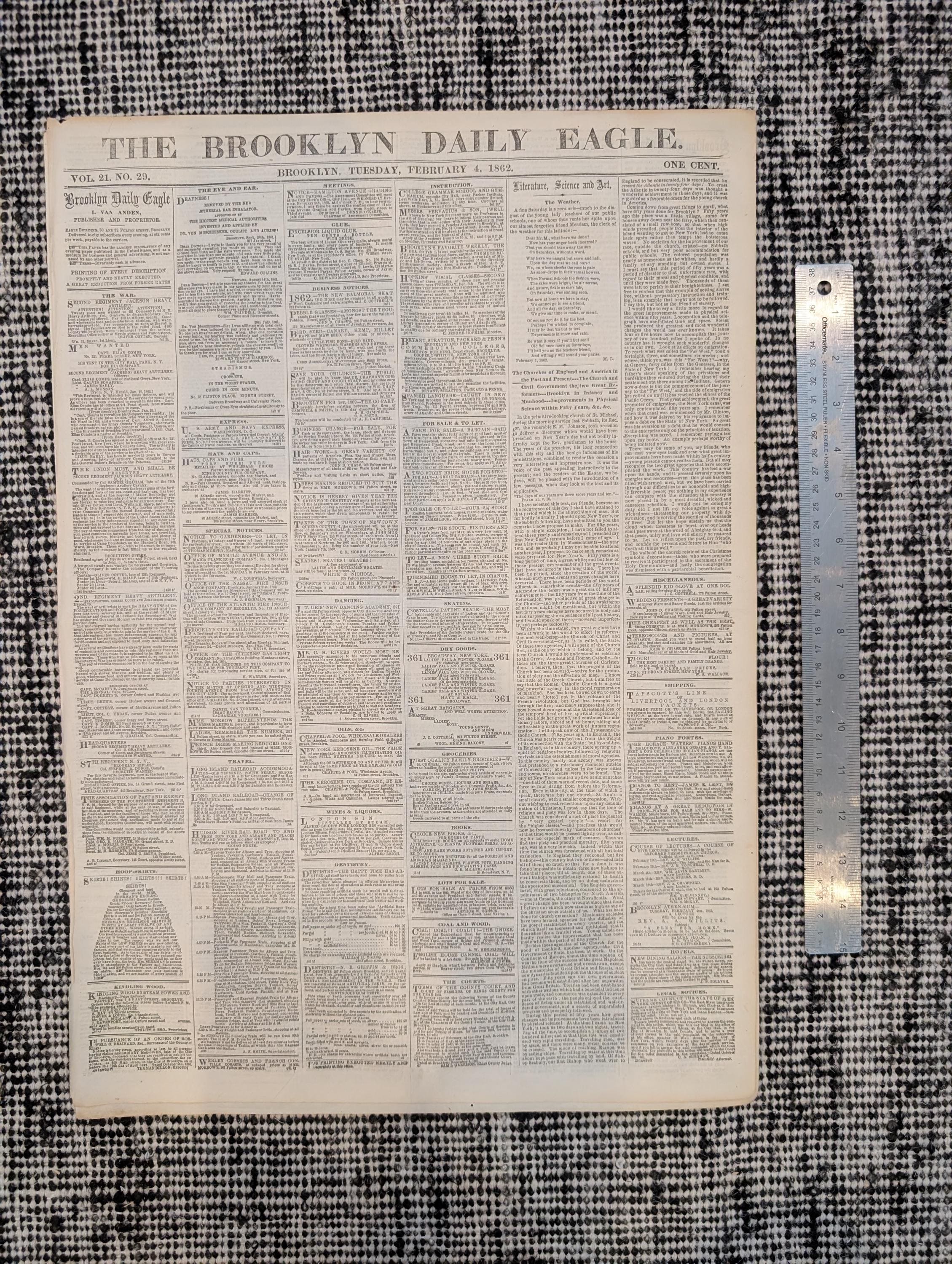
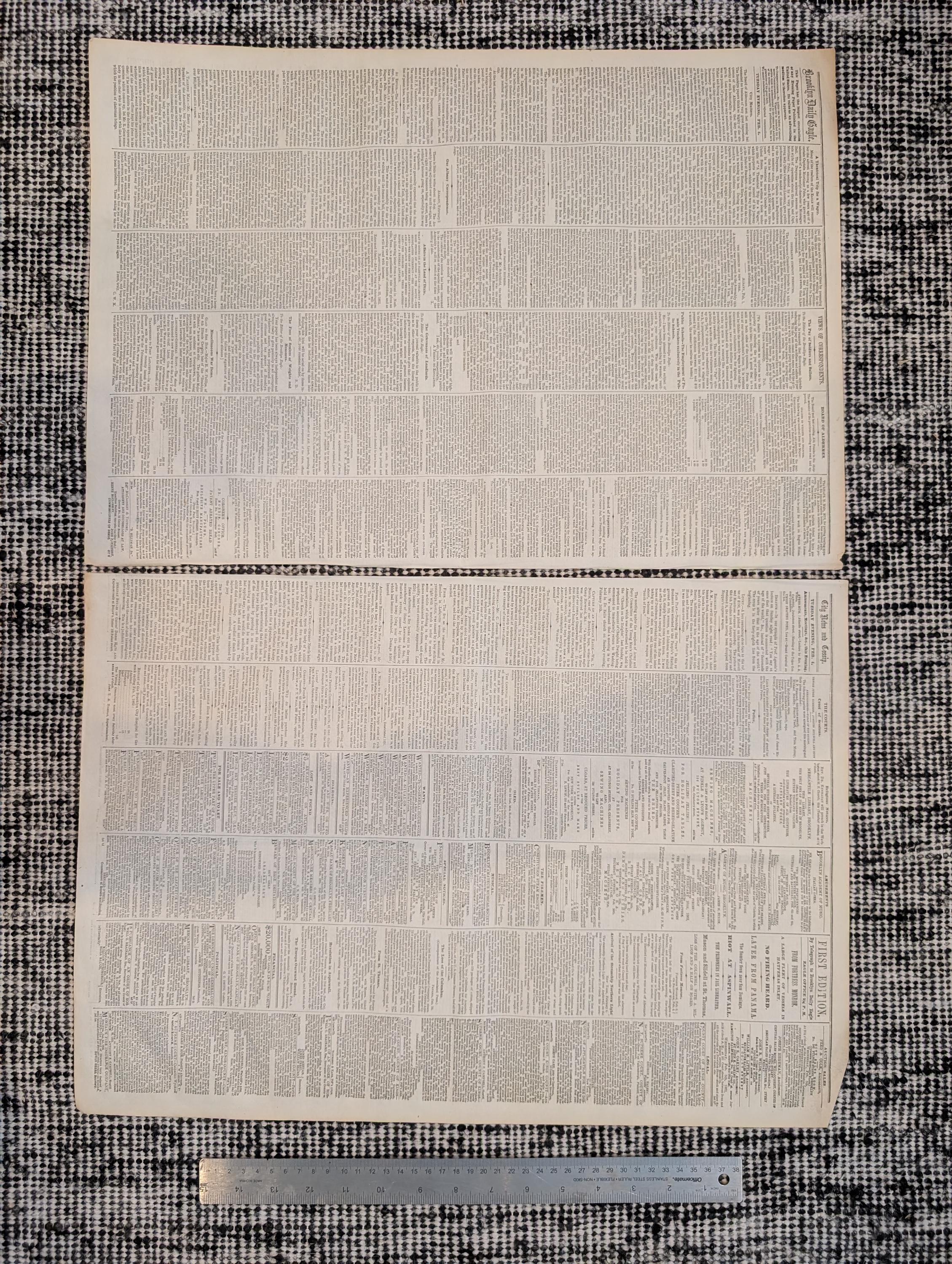
This February 4, 1862 issue of *The Brooklyn Daily Eagle* — Vol. 21, No. 29 — arrives two days before Grant's forces take Fort Henry, in the thick of a war that had already reached into Brooklyn homes and now fills this paper with regiment dispatches, casualty notices, and the particular grief of a community counting its own. It is also, on the same front page, the site of a sweeping historical essay on Brooklyn's own past — as if the city felt the need to understand where it came from precisely when everything was changing.
The Eagle, Walt Whitman's paper a decade earlier, now under publisher L. Van Ander, holds all of this without flinching: local death notices and literary weather poetry and stereoscope advertisements and a serialized novel about an interesting widow, all folded together and sold for one cent.
---
## ⚔️ "SECOND BROOKLYN'S DEATH" — LOCAL REGIMENT CASUALTIES ⚔️
The War column on the front page carries a headline that would have stopped every Brooklyn reader cold: **"Second Brooklyn's Death."** The Second Brooklyn regiment — men from these streets, from these neighborhoods, known to these readers — had taken losses. The Civil War's cruelest feature was its localism: regiments were raised by community, which meant that when a unit suffered, an entire block or congregation or church suffered with it. A death notice headed "Second Brooklyn" in the Brooklyn Daily Eagle was not an abstraction. It was a neighbor.
---
## 🏙️ "BROOKLYN IN INFANCY AND MANHOOD" — A HISTORY OF THE BOROUGH 🏙️
The **Literature, Science and Art** column of this issue carries a remarkable historical essay whose multi-part headline reads in full: **"The Churches of England and America in the Past and Present — The Church and Nonconformists — Brooklyn in Puritans' Reasons — Brooklyn in Infancy and Manhood — Movements in Philadelphia."**
This is a substantial piece of civic and religious history — tracing Brooklyn's origins through its Puritan and Dutch Reformed roots, through its growth into a major American city, and placing it in the context of the broader Anglo-American Protestant tradition. That the Eagle published this kind of sweeping local history in the middle of a civil war speaks to something important about how Victorian cities understood themselves: identity required origin stories, and origin stories required exactly this kind of ambitious historical journalism.
For collectors of Brooklyn history specifically, a primary-source essay on Brooklyn's founding and growth, published in Brooklyn in 1862, is a genuine find.
---
## ☁️ "THE WEATHER" — POETRY IN THE LITERATURE COLUMN ☁️
The **Literature, Science and Art** column also features a piece simply titled **"The Weather"** — a literary treatment of the season, presented in the Eagle's cultural column alongside the church history essay. Weather writing in Victorian newspapers occupied a strange and interesting space between meteorology, poetry, and philosophy: the season was both a physical fact and a moral condition, and the Eagle's treatment of it reflects the era's habit of finding meaning in the natural world. In February 1862, with armies bogged down in winter mud and frozen rivers across Virginia and Tennessee, weather was also a military subject — and a literary one simultaneously.
---
## 📸 STEREOSCOPE PHOTOGRAPHS — EARLY VICTORIAN PHOTOGRAPHY 📸
The front page carries advertisements for **"Stereoscopic and Pictures"** — a notable window into the rapidly expanding world of Victorian photography. The stereoscope was the era's dominant photographic entertainment: twin images mounted on cards, viewed through a hand-held device to produce a startling illusion of depth. By 1862, stereoscope cards were a mass market phenomenon, sold in shops like the one advertising in this column. For collectors of photography history or Victorian visual culture, the presence of stereoscope advertising in a Civil War-era daily is a fascinating document of how quickly photographic technology was commercializing during this period.
---
## 📖 "THE BOMBAY'S DAUGHTER: A TALE OF AN INTERESTING WIDOW" 📖
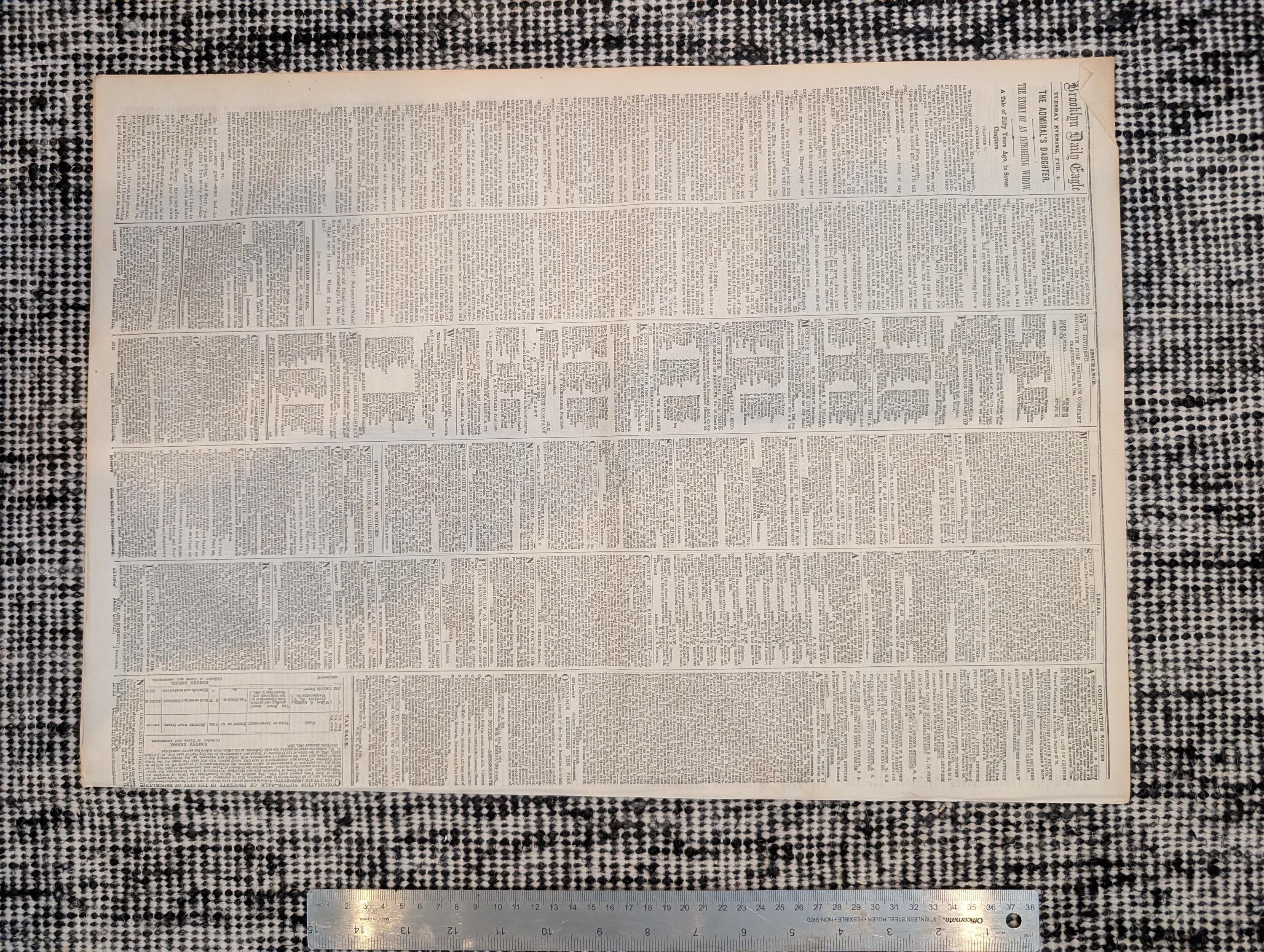
The back page — dateline **"Tuesday Evening, Feb. 4"** — opens with the serialized story **"The Bombay's Daughter: A Tale of an Interesting Widow."** This is an entirely different serial from the "Melodrama in a First Class Carriage" story that runs in later Eagle issues, and its title alone is a capsule of Victorian popular fiction conventions: the exotic locale (Bombay), the intriguing female protagonist (an interesting widow), and the promise of romance and complication. What brings a Bombay daughter to the pages of the Brooklyn Daily Eagle in February 1862 is the sort of question that makes Victorian serialized fiction endlessly fascinating.
---
## ⚔️ FIRST EDITION — VIRGINIA THEATER DISPATCHES ⚔️
The inner pages carry a **First Edition** breaking news insert with dispatches from the Virginia theater — the Army of the Potomac and its operations on the Upper Potomac and in northern Virginia. February 4, 1862 falls two days before the fall of Fort Henry, so the Western campaign had not yet produced its first breakthrough. The war news on this date is all from Virginia: McClellan's cautious winter preparations, skirmishing on river crossings, the logistical grinding of an army waiting for spring. The contrast between this anxious stasis and the dramatic news that would arrive within the week is part of what makes any Civil War daily a document of genuine suspense.
---
## 🗣️ CITY ITEM AND GOSSIP 🗣️
The inner pages carry the **"City Item and Gossip"** column — the Eagle's running account of Brooklyn street life, neighborhood incident, and municipal chatter. In February 1862, Brooklyn was a city being reshaped by the war: recruitment offices open, men departing, women running households and businesses alone, prices changing, and the social fabric stretching in ways that formal histories rarely capture. The gossip column does.
---
## 🗞️ THE FULL FRONT PAGE 🗞️
The front page covers the complete texture of wartime Brooklyn life:
- **The War** — front-page dispatches and casualty notices
- **87th Brooklyn, N.Y.** — regimental notice and military news
- **Men Wanted** — military recruitment alongside civilian employment
- **"The Great Hub and Shall It Be..."** — editorial on the Union cause
- **The Eye and Ear** — specialty medical column on ophthalmology and audiology
- **Meetings** — civic and community notices
- **Instruction** — Brooklyn educational advertisements
- **Express** — delivery services
- **Hats and Caps** — Brooklyn retail
- **Special Notices / Official Notices** — civic announcements
- **Notice of Hardening to Let** — property notices
- **Business Notices / 1862** — commercial announcements
- **Travel** — passenger and shipping notices
- **"Tale of the Town of New York"** — urban news coverage
- **Skating** — winter leisure advertisements
- **Dancing** — "J. Chip's New Dancing Academy"
- **Power Change — For Sale** — commercial notices
- **Dry Goods — 361 Broadway** — prominent display advertisement
- **Oil and Books** — bookseller notices
- **Love for Sale** — classified personal notice
- **Coal and Wood** — winter fuel market
- **The Courts** — Brooklyn legal proceedings
- **Dentistry — "The Happy Time Has Al..."** — dental advertisement
- **Wines and Liquors** — Brooklyn merchants
- **Tapscott's Line — Liverpool and London** — transatlantic shipping
- **Piano Fortes** — "The Great Watson Pianos"
- **Course of Lectures** — public lecture series
- **Hoop-Skirts — Perfect!** — Victorian fashion
- **Kindling Wood** — winter fuel
- **In Pursuance of an Order** — legal/official notice
---
## 🔍 CONDITION & TRANSPARENCY 🔍
**Authenticity:** Guaranteed original letterpress printing from February 4, 1862 — not a reproduction.
**Condition Report:** Consistent with its 163-year age. Natural toning to newsprint throughout. Some edge wear visible. Text remains legible across all columns. Civil War-era daily papers were printed on perishable newsprint and almost never deliberately saved — any intact example is a scarce survivor.
Please review all photographs carefully. I'm happy to photograph any specific section in greater detail before you purchase.
---
## 📦 SHIPPING & PRESERVATION 📦
- Housed in an acid-free archival folder
- Flat-shipped with heavy-duty reinforcement
- Fully tracked
---
Two days before Fort Henry. The war column says "Second Brooklyn's Death." The literature column is tracing Brooklyn back to the Puritans. The back page is about an interesting widow from Bombay. All of it, for one cent.
---
## 🏷️ TAGS
1862 Brooklyn Daily Eagle Civil War, Brooklyn History Puritans 1862, Second Brooklyn Regiment Civil War, Civil War Casualties Brooklyn, Victorian Stereoscope Photography 1862, Antique Newspaper February 1862, Brooklyn Daily Eagle Walt Whitman, Civil War Home Front Primary Source, Victorian Serialized Fiction, Brooklyn in Infancy Manhood, Civil War Regiment Newspaper, Victorian Photography Stereoscope, Brooklyn History Newspaper 1862, Army of the Potomac 1862, Civil War Daily Newspaper Brooklyn -
Shipping & Policies
Related Products