
Americana
1862 Brooklyn Daily Eagle — Battle of Somerset First Edition, Runaway Slave, Jan. 22
$77.77
-
Details📜 ABOUT THIS PIECE OF HISTORY 📜
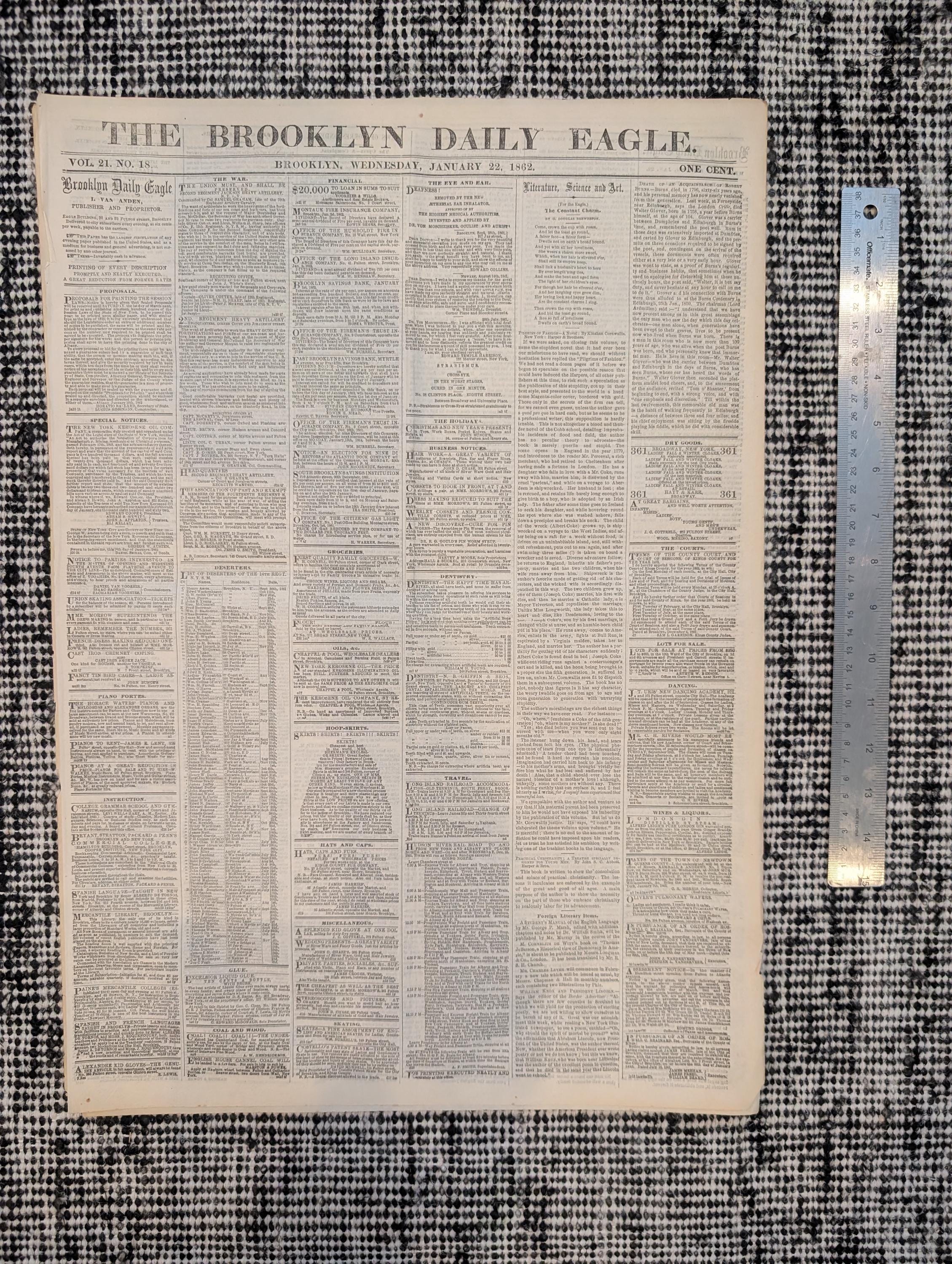
This January 22, 1862 issue of The Brooklyn Daily Eagle — Vol. 21, No. 18, a Wednesday — is the most historically charged issue in this entire run of papers, year to date. Its First Edition insert carries the breathless breaking news of one of the Civil War's first decisive Union victories, telegraphed to the Eagle's office at 2 P.M. and rushed into print the same afternoon. And its front page carries a piece about a runaway slave arriving at someone's door — a story that cuts to the absolute moral heart of the conflict.
For Civil War collectors, this is not merely a newspaper from the era. It is a primary-source document of the exact moment Brooklyn received news of the Battle of Mill Springs.
---
⚔️ FIRST EDITION — "THE BATTLE AT Somerset — HIGHLY IMPORTANT" ⚔️
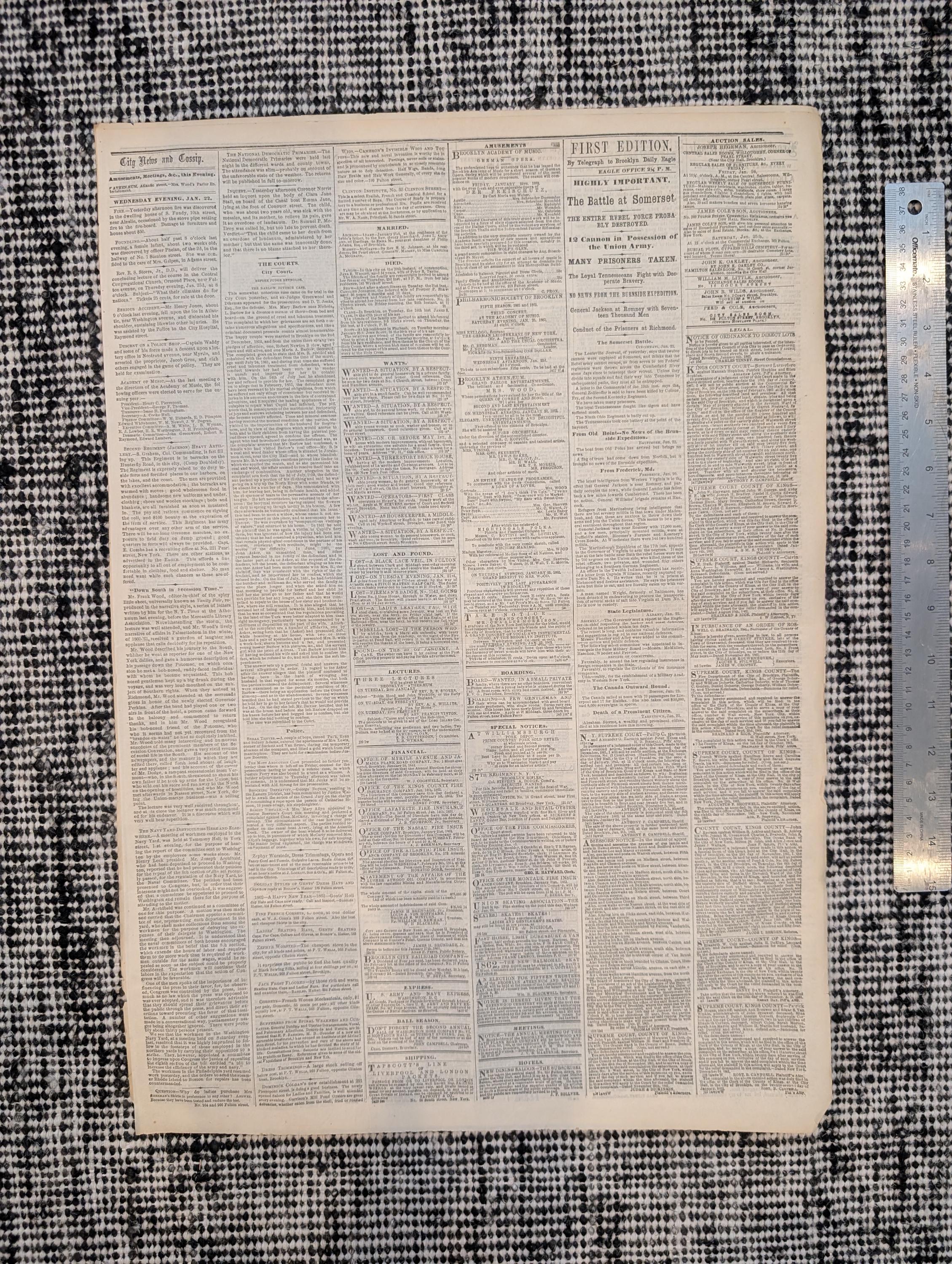
The inner pages carry a First Edition insert telegraphed to the Brooklyn Daily Eagle at 2 P.M. on January 22, 1862. The headlines, printed bold and stacked, read in full:
FIRST EDITION
By Telegraph to Brooklyn Daily Eagle
EAGLE OFFICE 2 P.M.
HIGHLY IMPORTANT.
The Battle at Somerset
THE ENTIRE REBEL FORCE PROBABLY DESTROYED
12 Cannon in Possession of the Union Army.
MANY PRISONERS TAKEN.
The Legal Tennesseans Fight with Desperate Bravery.
NO NEWS FOR THE BURNSIDE EXPEDITION.
General Jackson at Romney with Seventeen Thousand Men.
Conduct of the Prisoners at Richmond.
The Battle of Somerset — more commonly known as the Battle of Mill Springs or Logan's Cross Roads — was fought on January 19, 1862, three days before this paper. It was the first major Union victory of the entire Civil War in the Western Theater.
Confederate General George Crittenden's forces, commanded in the field by Brigadier General Felix Zollicoffer, had crossed the Cumberland River in a bold but reckless assault on Union forces under General George Thomas. Zollicoffer was killed in the fighting — one of the first Confederate generals to die in combat. The Confederate army was routed, twelve artillery pieces captured, and Confederate control of eastern Kentucky effectively shattered. The road to Tennessee was now open.
When Brooklyn read this First Edition on January 22, 1862, the news would have produced something the city had not felt in months: genuine, verifiable hope. The Union had been suffering through a long winter of military frustration — McClellan's inaction in Virginia, the stalemate on every front. Somerset broke that stalemate. It was, at that moment, the best news the North had received since the war began.
The further headlines carry their own weight: "No News for the Burnside Expedition" reflects the separate anxiety Brooklyn held about the fleet off the Carolina coast. "General Jackson at Romney with Seventeen Thousand Men" — Stonewall Jackson, consolidating his position in the Shenandoah. "Conduct of the Prisoners at Richmond" — the treatment of Union prisoners was already becoming a national political concern.
This First Edition is a primary-source document of the moment a Brooklyn afternoon changed.
---
🚪 "A RUNAWAY SLAVE AT OUR DOOR" 🚪
The front page carries a piece headlined **"A Runaway Slave at our Door"** — a remarkable piece of Civil War home-front journalism describing the arrival of a freedom seeker at a Brooklyn residence. By January 1862, the question of what to do when an enslaved person escaped and arrived in the North was one of the most politically explosive questions in American life.
General Benjamin Butler's "contraband" ruling of May 1861 had established that escaped enslaved people reaching Union lines could be considered contraband of war and not returned — but that ruling applied to military lines, not civilian households in Brooklyn. The Fugitive Slave Act of 1850 still technically required Northerners to assist in the return of freedom seekers. Brooklyn was a city deeply divided on these questions: it had large Democratic and pro-Southern commercial interests alongside its abolitionist community.
A piece headlined "A Runaway Slave at our Door" — published three days after the Battle of Somerset, as the war's meaning was being renegotiated in real time — is one of the most historically charged pieces of journalism in this entire run of Eagle issues.
---
🏛️ "THE CROMWELL CHASE" — LITERATURE AND HISTORY 🏛️
The Literature, Science and Art column leads with a substantial piece on **"The Cromwell Chase"** — a literary and historical treatment of Oliver Cromwell and his pursuit of the royalists, almost certainly an essay drawing parallels between the English Civil War and America's own conflict. Cromwell was a figure Victorian Americans thought about carefully: a man who had taken a republic to war against itself, executed a king, and created a revolutionary government that ultimately gave way to restoration. The lesson was complicated. The essay reflects how deeply educated Brooklynites were searching history for maps to the present.
---
🔥 "THE CREMATORY AS WELL AS THE SOD" — AN EARLY CREMATION DEBATE 🔥
The front page carries a notice or feature headed **"The Crematory as Well as the Sod"** — an early piece on the debate over cremation as an alternative to burial. In 1862, cremation was a genuinely radical proposition: the first crematorium in America would not open until 1876. The piece reflects the Victorian press's willingness to engage with controversial and unconventional ideas even in wartime — and the particular urgency that the question of what to do with the dead had taken on as the war's casualties mounted.
---
🗞️ THE CITY NEWS AND GOSSIP COLUMN 🗞️
The inner pages carry a rich **"City News and Gossip"** column dated **"Wednesday Evening, Jan. 22"** covering the full texture of Brooklyn street life — fires, courts, incidents, neighborhood notes, the movements of public figures, and the small human dramas of a city at war. Sections include:
- "Down South in Troublous Times" — a correspondent's report from the South
- The National Democratic Primaries — political party coverage
- Fire coverage — Brooklyn Fire Department incidents
- "Lost — A Black Calf Veal" — period Lost and Found
- "Lost — Thomas Station No. 100 Duffy"
- "Wanted — Situation at a Respectable House"
- Court proceedings — City Court, Sessions
- "Conduct of the Prisoners at Richmond" — prisoner of war coverage
---
🎵 AMUSEMENTS AND CONCERTS 🎵
The inner pages carry an Amusements section covering Brooklyn and New York theatrical and concert life — the lecture season, musical performances, and entertainment notices for a city that continued its cultural life even in the depths of a wartime January.
---
📖 "A THRILLING AUTOBIOGRAPHY" — EVENING SERIAL 📖
The back page continues **"A Thrilling Autobiography — A Tale in Two Parts"** — the Eagle's current serialized fiction piece, offering Wednesday evening readers their regular installment of narrative adventure alongside the Somerset dispatches and the Cromwell essay.
---
🗞️ ADDITIONAL FRONT-PAGE CONTENT 🗞️
- The War — front-page war dispatches
- Financial — $20,000 in Home Rural Notes, Brooklyn Savings Bank January dividend, Office of the Fireman's Trust Co., Office of the Long Island Insurance Company, Brooklyn National Bank January, Part Brooklyn Fire Department
- Special Notices — various civic announcements, Office of the Nassau Fire, Notice for Election for New officers
- Deserters — list of military deserters being sought
- Dentistry — period dental advertisements
- Hoop-Skirts — "Skirts! Skirts! Skirts! Skirts!"
- Groceries — wartime provisions
- Glue and related goods
- Coal and Wood — winter fuel
- Skating — winter leisure
- Travel — Long Island Railroad
- Hats and Caps — Brooklyn retail
- Piano Fortes — musical instruments
- Instruction — Commercial College
- Miscellaneous Library notices
- Pusey Mercantile College
- Stairs and Blinds
- A Married Groom... — personal notice
- Waltz Concerts and Piano-Forte notices
- A New Specific Cure for Tic — medical advertisement
- "Proposals — A Specific Cure for Tic"
---
📦 SHIPPING & PRESERVATION 📦
Housed in an acid-free archival folder
Flat-shipped with heavy-duty reinforcement
Fully tracked
---
On January 22, 1862, at 2 P.M., the telegraph brought Brooklyn the news from Somerset. The entire rebel force probably destroyed. Twelve cannon taken. A runaway slave had arrived at someone's door. Oliver Cromwell was being compared to the present war. And Arthur of Firona's story continued into Wednesday evening, because it always did.
---
🏷️ TAGS
1862 Brooklyn Daily Eagle, Battle of Somerset Mill Springs 1862, Civil War First Edition Breaking News, Battle of Mill Springs Logan's Cross Roads, Union Victory Kentucky January 1862, Zollicoffer Death Civil War, George Thomas Union General, Runaway Slave Brooklyn 1862, Fugitive Slave Act Civil War, Burnside Expedition 1862, Victorian Cremation Debate, Oliver Cromwell Civil War History, Brooklyn Civil War Primary Source, Walt Whitman Brooklyn Eagle, Civil War First Major Union Victory -
Shipping & Policies
Related Products