
Americana
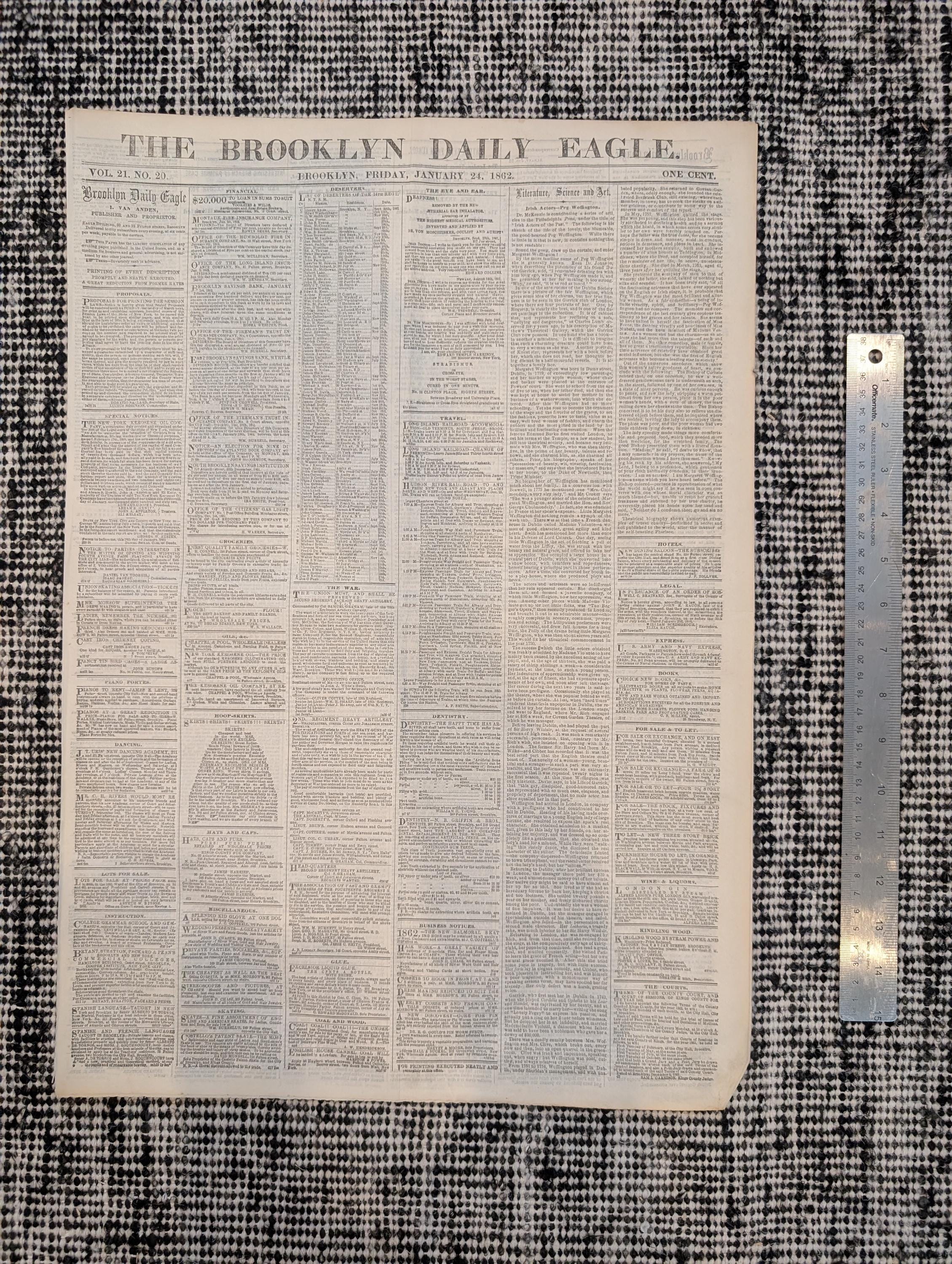
1862 Brooklyn Daily Eagle — Capture of Cedar Key Florida, Cross of War, Jan. 24
$44.44
-
Details📜 ABOUT THIS PIECE OF HISTORY 📜
This January 24, 1862 issue of The Brooklyn Daily Eagle — Vol. 21, No. 20, a Friday — carries a First Edition breaking news insert announcing one of the more overlooked Union victories of the early war: the capture of Cedar Key, Florida. That headline — "HIGHLY IMPORTANT — CAPTURE OF CEDAR KEY, FLA." — would have stopped Brooklyn readers in their tracks. After months of Union military frustration, any victory, anywhere, mattered enormously. Cedar Key's fall meant Union control of a significant Gulf Coast position and a severing of Confederate railroad access to the Florida coast.
This copy is in very good condition, with clear printing and good paper stability throughout.
---
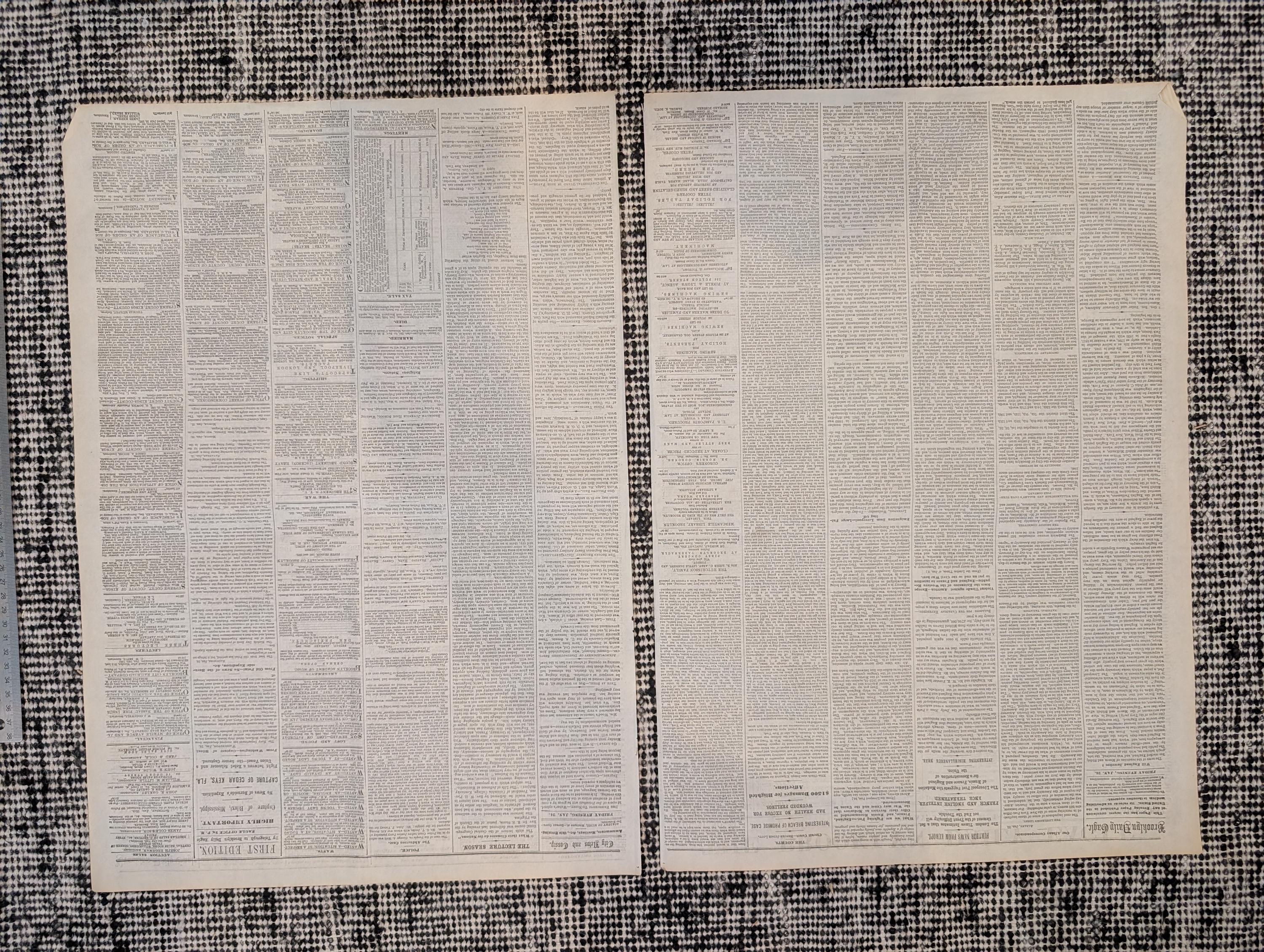
⚓ FIRST EDITION — "HIGHLY IMPORTANT — CAPTURE OF CEDAR KEY, FLA." ⚓
The inner pages carry a First Edition breaking news insert headlined **"HIGHLY IMPORTANT"** — the Eagle's signal of genuinely significant military news — with the subheadline **"CAPTURE OF CEDAR KEY, FLA., by the Naval Forces of Fort Beauregard."**
Cedar Key was a small but strategically meaningful Gulf Coast port on Florida's west coast. Its rail connection to Fernandina on the Atlantic coast made it a Confederate supply and communication link that Union naval forces had been targeting. The capture was carried out by the Union Navy operating in the Gulf, part of the broader Anaconda Plan to strangle Confederate commerce and communications along the coast. The headline's attribution to "Fort Beauregard" — a Union-named position honoring nothing of the Confederate general of the same name — adds a period irony.
For collectors of Civil War naval history, Florida Civil War history, or the Union's coastal campaign, this First Edition dispatch is a primary-source document of a specific, named military action on a specific date.
---
✝️ "THE CROSS OF WAR" — A MAJOR EDITORIAL ✝️
The front page carries a large editorial piece headlined **"THE CROSS OF WAR"** — a sustained moral and philosophical reflection on the meaning of the conflict engulfing the nation. Victorian editorial writing at its most ambitious aimed to do exactly what this headline promises: to locate the war within a larger framework of suffering, sacrifice, meaning, and national purpose. The cross is simultaneously the Christian symbol of redemption through suffering and the literal crossing — the burden — of wartime existence.
That the Eagle published this kind of extended moral editorial in January 1862, when the war was at its most frustrating and directionless phase, speaks to how desperately the paper's readers needed someone to make sense of what was happening to them. "The Cross of War" is that attempt, in print, from Brooklyn, in January 1862.
---
🎭 "IRISH ACTORS — PRE-WASHINGTON" — THE LITERATURE COLUMN 🎭
The Literature, Science and Art column leads with a piece on **"Irish Actors — Pre-Washington"** — a cultural and theatrical history article examining the tradition of Irish performers in America before the Washington era. Irish immigration had been transforming New York and Brooklyn for two decades since the Famine, and the presence of Irish theatrical culture — its distinctive comedy, melodrama, and music hall tradition — was a significant force in the entertainment life of Civil War Brooklyn. A feature tracing that tradition back to its pre-Revolutionary roots is an unusual and valuable piece of cultural journalism.
---
💒 MARRIAGES COLUMN 💒
The inner pages carry a dedicated **"Marriages"** section — the formal announcement of Brooklyn weddings, with names, dates, officiating clergy, and family details. In January 1862, with men leaving for the front and the future uncertain, the marriages recorded here carry a particular weight. A Brooklyn couple marrying in January 1862 was making a bet on the future at exactly the moment the future was most opaque. The names in this column are genealogical documents — dated, specific, located in Brooklyn — of real people at a real turning point.
---
🎓 "THE LECTURE SEASON" — BROOKLYN'S INTELLECTUAL LIFE 🎓
The inner pages again carry **"The Lecture Season"** column, tracking Brooklyn's active public lecture circuit through the winter of 1862. The lecture was the era's dominant form of public intellectual life — the TED Talk and podcast of the 19th century — and Brooklyn's lyceum halls were consistently full even as the war consumed national attention. The Eagle's dedicated coverage of who was lecturing, where, and to what effect reflects a reading public that insisted on its intellectual life even under the pressure of catastrophe.
---
📖 "A THRILLING AUTOBIOGRAPHY — A TALE IN TWO PARTS" 📖
The back page, dated "Friday Evening, Jan. 24," continues the serialized **"A Thrilling Autobiography — Arthur of Firona, &c. — A Tale in Two Parts"** — the Eagle's current fiction serial, running through this final week of January 1862. Friday evening's installment would have been read over the coming weekend — the story carrying Brooklyn readers out of the war news and into the romantic adventures of a man named Arthur.
---
🗞️ THE FULL FRONT PAGE — WARTIME BROOKLYN IN DETAIL 🗞️
Beyond the major features, the front page covers the full texture of a wartime Brooklyn Friday:
- Financial — $20,000 loan in Home Rural Notes, Fireman's National Bank January dividend
- Proposals — printing proposals
- Special Notices — New York Express Quote, various civic announcements
- Office of the Citizen's Gas Light company
- Notice to Parties Interested In — civic and legal notices
- First Quality Family Groceries
- Flour — wholesale market prices
- Playing Card Cases — retail advertisement
- Glue and related goods
- Skating — winter leisure
- Piano to Let — Jane D. Levy notice
- Dancing — J. Crisp's New Dancing Academy
- Miscellaneous — including personal notices
- 40 — Strawbridge and Flowers — retail
- Hats and Caps — Brooklyn retail
- Job Wanted — employment notices
- Lots for Sale — Brooklyn real estate
- Instruction — educational notices
- Composteria — printing trade notice
- A Celebrated Trial in the... — legal proceedings
- Dentistry — period dental advertisements including "Dentistry — The Happy Times Has Ar..."
- Travel — Long Island Railroad
- Business Notices 1862
- Hoop-Skirts — "Skirts! Skirts! Skirts! Skirts!"
- 2nd Regiment Heavy Artillery — Brooklyn regiment notices
- 11th Regiment — regimental news
- For Sale & To Let — Brooklyn real estate
- Kindling Wood
- The Courts — Brooklyn legal proceedings
---
📦 SHIPPING & PRESERVATION 📦
Housed in an acid-free archival folder
Flat-shipped with heavy-duty reinforcement
Fully tracked
---
On January 24, 1862, the Union Navy took Cedar Key. The Eagle published a meditation on the meaning of war. An Irish theatrical tradition was traced back to the founding era. And Arthur of Firona's story continued into Friday evening. A full day in a city that refused to stop thinking.
---
🏷️ TAGS
1862 Brooklyn Daily Eagle, Capture Cedar Key Florida 1862, Civil War Naval Victory Florida, Union Navy Gulf Coast 1862, Cross of War Editorial Civil War, Irish Actors American Theater History, Civil War Marriages Brooklyn 1862, Brooklyn Genealogy Marriage Records, Walt Whitman Brooklyn Eagle, Civil War Lecture Season Brooklyn, Antique Newspaper January 1862, Civil War Primary Source Brooklyn, Victorian Editorial Civil War Meaning, Brooklyn History 1862, Civil War Naval Campaign Florida -
Shipping & Policies
Related Products