Americana
1862 Brooklyn Daily Eagle — About War and Warriors, Greek War Essay, Feb. 3
$44.44
-
Details📜 ABOUT THIS PIECE OF HISTORY 📜
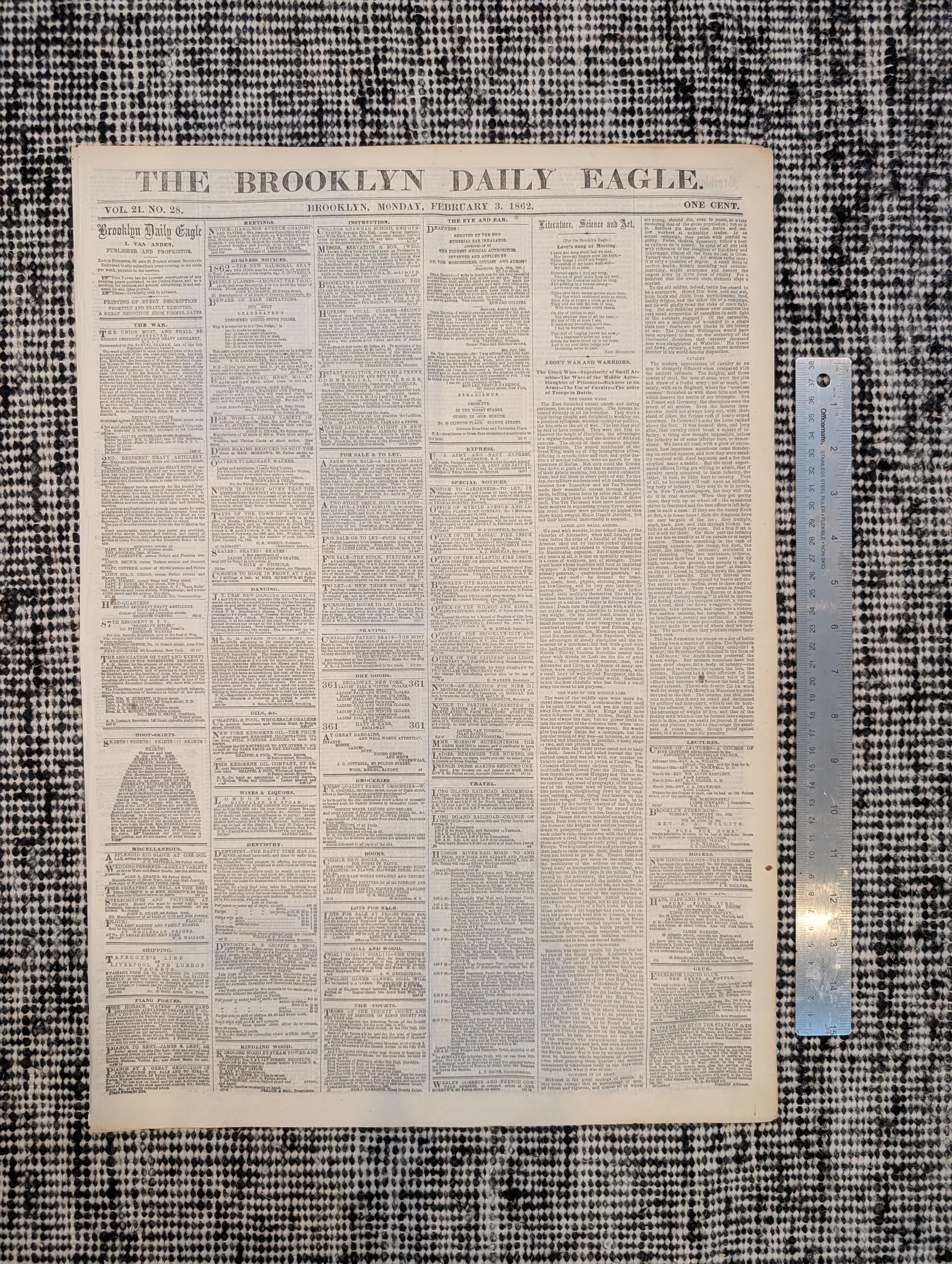
This February 3, 1862 issue of The Brooklyn Daily Eagle — Vol. 21, No. 28 — arrives three days before Grant takes Fort Henry and the Western Theater cracks open. On this Monday morning, the war is still in its long, grinding winter stasis: armies watching each other across frozen rivers, no great battles won or lost. Into that anxious quiet, the Eagle's Literature, Science and Art column publishes one of the most intellectually ambitious pieces of war journalism that appears in this run of issues — a sweeping essay on the nature of war itself.
---
⚔️ "ABOUT WAR AND WARRIORS" — A MAJOR ESSAY ON MILITARY HISTORY ⚔️
The centerpiece of this issue is a substantial front-page essay in the Literature, Science and Art column under the title "About War and Warriors." Its subheadlines announce an extraordinarily ambitious scope:
"The Greek War — Superiority of Small Armies — Fate of the Soldier — Treatment of Prisoners — Sickness in the Army — Waste of the War — or Troops in Battle"
This is military philosophy journalism at its most serious: drawing on the wars of ancient Greece to analyze the Civil War the Eagle's readers were living through. The argument that small, disciplined armies are superior to mass armies would have landed with real force in February 1862, when the Union's vast but unwieldy forces had so far failed to deliver decisive results. The sections on the treatment of prisoners and sickness in the army were immediately relevant — prisoner-of-war conditions were already becoming a political flashpoint, and battlefield disease was killing more soldiers than bullets. That the Eagle published this kind of extended historical-military analysis for a popular daily readership speaks to the intellectual seriousness of Victorian journalism, and to how desperately Brooklyn readers wanted to make sense of the war engulfing them.
---
🎵 "BROOKLYN SINGS AT MORNING" — A POEM IN THE EAGLE 🎵
The Literature column also carries a poem titled "Brooklyn Sings at Morning" — submitted to the Eagle for publication. The presence of civic poetry in the Eagle during the Civil War is a reminder that Brooklyn understood itself as a city with a literary identity, not merely a commercial one. Walt Whitman had edited this paper a decade earlier; the tradition of publishing poetry alongside news dispatches was very much alive. A poem celebrating Brooklyn's morning — published while the city's sons were at war — carries an obvious emotional weight that the Eagle's editors clearly recognized.
---
📚 THE BOOKS COLUMN — COOPER, FIELDING, BULWER, DICKENS 📚
The Books section of this issue advertises the works of four canonical authors of Anglo-American literature: James Fenimore Cooper, Henry Fielding, Edward Bulwer-Lytton, and Charles Dickens. This is a snapshot of the Victorian literary canon as it existed in early 1862 — the books a middle-class Brooklyn household was expected to own, read, and pass down. Dickens was at the peak of his fame; Cooper's Leatherstocking Tales were American literary scripture; Fielding's Tom Jones remained a fixture of educated reading; and Bulwer-Lytton, largely forgotten today, was one of the most widely read novelists of the mid-Victorian era. For literary history collectors, this column is a primary-source document of what "literature" meant in Civil War-era Brooklyn.
---
⚔️ FIRST EDITION — "FROM THE UPPER POTOMAC" ⚔️
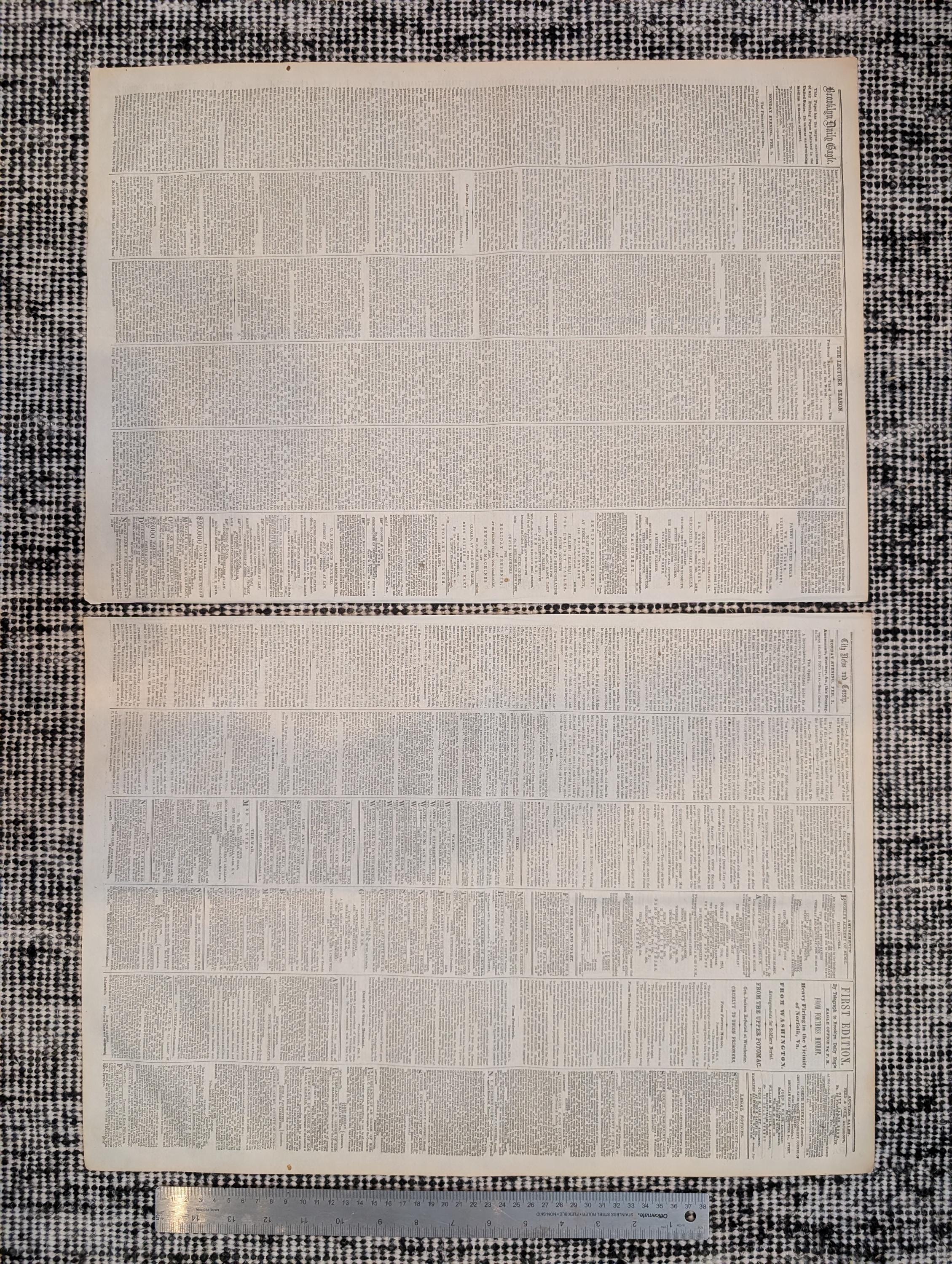
The inner pages carry a First Edition breaking news insert with dispatches "From the Upper Potomac" and "From Washington" — the Army of the Potomac's operations in the northern Virginia theater. February 3, 1862 falls in the long winter pause before the spring campaigns: McClellan's massive army was still preparing, still training, still frustrating Lincoln with its inaction. The Upper Potomac dispatches — covering skirmishing, reconnaissance, and troop movements near Harpers Ferry — capture that anxious, uncertain interlude before the war's first decisive campaigns began.
---
🎭 "THE BOMBAY'S DAUGHTER" — EVENING SERIAL 🎭
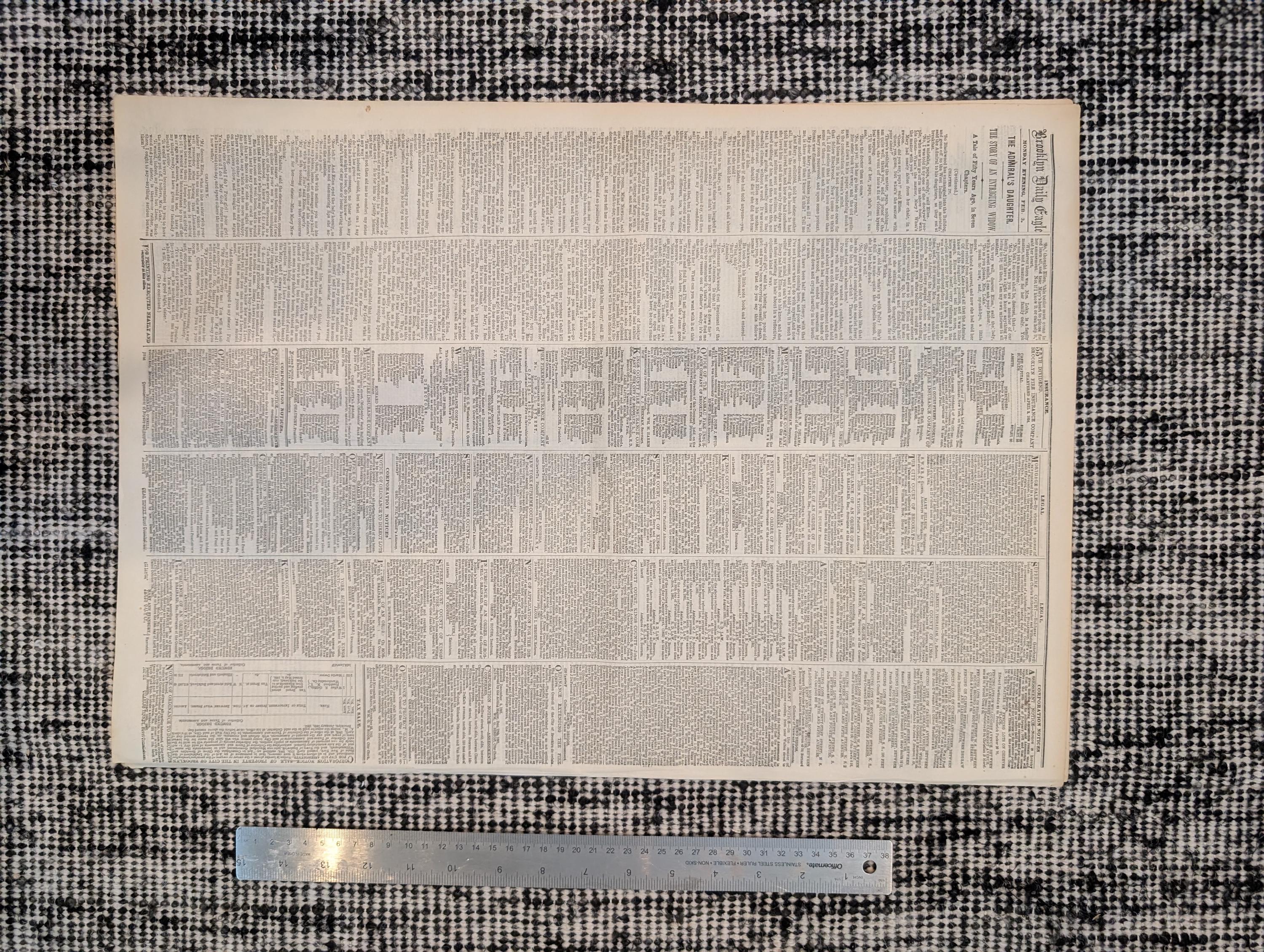
The back page, dated "Monday Evening, Feb. 3," continues the serialized Victorian fiction piece "The Bombay's Daughter: A Tale of an Interesting Widow" — the nightly installment of the Eagle's serialized novel, offering Brooklyn readers their regular dose of dramatic fiction alongside the war dispatches. The serial was the era's dominant popular entertainment form, and the contrast between this night's installment and the "About War and Warriors" essay running on the front page captures the Eagle's essential character: a paper that took both the life of the mind and the pleasures of narrative entertainment seriously.
---
🗞️ THE FULL FRONT PAGE — WARTIME BROOKLYN IN DETAIL 🗞️
Beyond the major features, the front page is dense with the texture of daily wartime life:
- The War — front-page dispatches from multiple theaters
- Second Brooklyn Draft Artillery — specific Brooklyn regiment notices
- 87th Regiment, N.Y. — regimental news and recruiting
- Meetings — Nostrand Avenue Church notices
- Instruction — College Grammar School advertisements
- The Eye and Ear — ophthalmology and audiology column
- Business Notices — 1862 commercial announcements
- "Beware of Lost Imitations" — consumer warning notice
- Canvassers — "In the Wilder Stages, No. 46 Clinton Place, Bleecker Street"
- Express — U.S. and Adams Express notices
- Hats and Caps — Brooklyn retail
- Skating — "Skates! Skates! Skates!" — winter leisure
- Dancing — "J. Crisp's New Dancing Academy"
- For Sale & To Let — Brooklyn real estate
- Special Notices — insurance and civic announcements
- "Office of the Brooklyn City and Railroad Company"
- Dry Goods — 361 Broadway — prominent display advertisement
- Travel — Long Island Railroad accommodations and schedule changes
- Groceries — "First Quality Family Groceries"
- Love for Sale — classified personal notice
- Coal and Wood — "Cool! Cool! — The Union" — wartime fuel market
- English House Candles — period household goods
- The Courts — Brooklyn legal proceedings
- Dentistry — "The Happy Time Has Al..." — dental advertisement
- Miscellaneous — including "Stereoscope and Pictures" — Victorian photography advertisements
- Shipping — Tapscott's Line, Liverpool and London
- Piano Fortes — musical instrument dealers
- Kindling Wood — "Kindling Wood by Steam Power and Horse Power"
- Hoop-Skirts — Victorian fashion
- City Item and Gossip — Brooklyn street-level news and neighborhood chatter
---
🔍 CONDITION & TRANSPARENCY 🔍
Authenticity: Guaranteed original letterpress printing from February 3, 1862 — not a reproduction.
Condition Report: Consistent with its 163-year age. Natural toning to newsprint throughout. Some edge wear visible. Text remains legible across all columns. Civil War-era daily papers were printed on perishable newsprint and almost never deliberately preserved — any intact example is a scarce survivor.
Please review all photographs carefully. Happy to photograph any specific section in greater detail before you purchase.
---
📦 SHIPPING & PRESERVATION 📦
Housed in an acid-free archival folder
Flat-shipped with heavy-duty reinforcement
Fully tracked
---
On February 3, 1862, Brooklyn was three days away from the first great Union victory of the war — but nobody knew that yet. The Eagle published an essay on the Greek wars. A poem about Brooklyn mornings. A list of Dickens novels for sale. And a serial about a widow from Bombay. The war was out there. Life was in here.
---
🏷️ TAGS
1862 Brooklyn Daily Eagle, Civil War Military History Essay, Greek War Small Armies 1862, Civil War Prisoner Treatment, Victorian Literary Canon Dickens Cooper, Brooklyn Civil War Newspaper February 1862, Army of the Potomac Upper Potomac 1862, Victorian Serialized Fiction, Second Brooklyn Regiment Artillery, Civil War Daily Newspaper, Brooklyn History 1862 Primary Source, Walt Whitman Brooklyn Eagle, Antique Newspaper 1862, Civil War Home Front Brooklyn, Victorian Military Philosophy -
Shipping & Policies
Related Products