Americana
1880 Chautauqua, Boston Drainage, Mentone, Walt Whitman — Harper's Weekly — Aug 21
$38.88
-
Details📜 ABOUT THIS PIECE OF HISTORY 📜
The August 21, 1880 issue of Harper's Weekly is one of the most historically varied and surprising issues of the entire summer run — three Thomas Nast political cartoons keep the presidential election watch in full force, the double-page centerfold transports readers to the shores of Lake Chautauqua in nine scenes of the most extraordinary adult education experiment in American history, Boston's great main drainage works fill a full page with eight scenes of Victorian engineering ambition, and the French Riviera town of Mentone opens onto the Mediterranean world in eight views of one of the most fashionable destinations in Europe. And tucked into the text on page 531, almost casually, is a note about Walt Whitman — one of the most important sentences about one of the most important American poets in the entire Harper's Weekly archive.
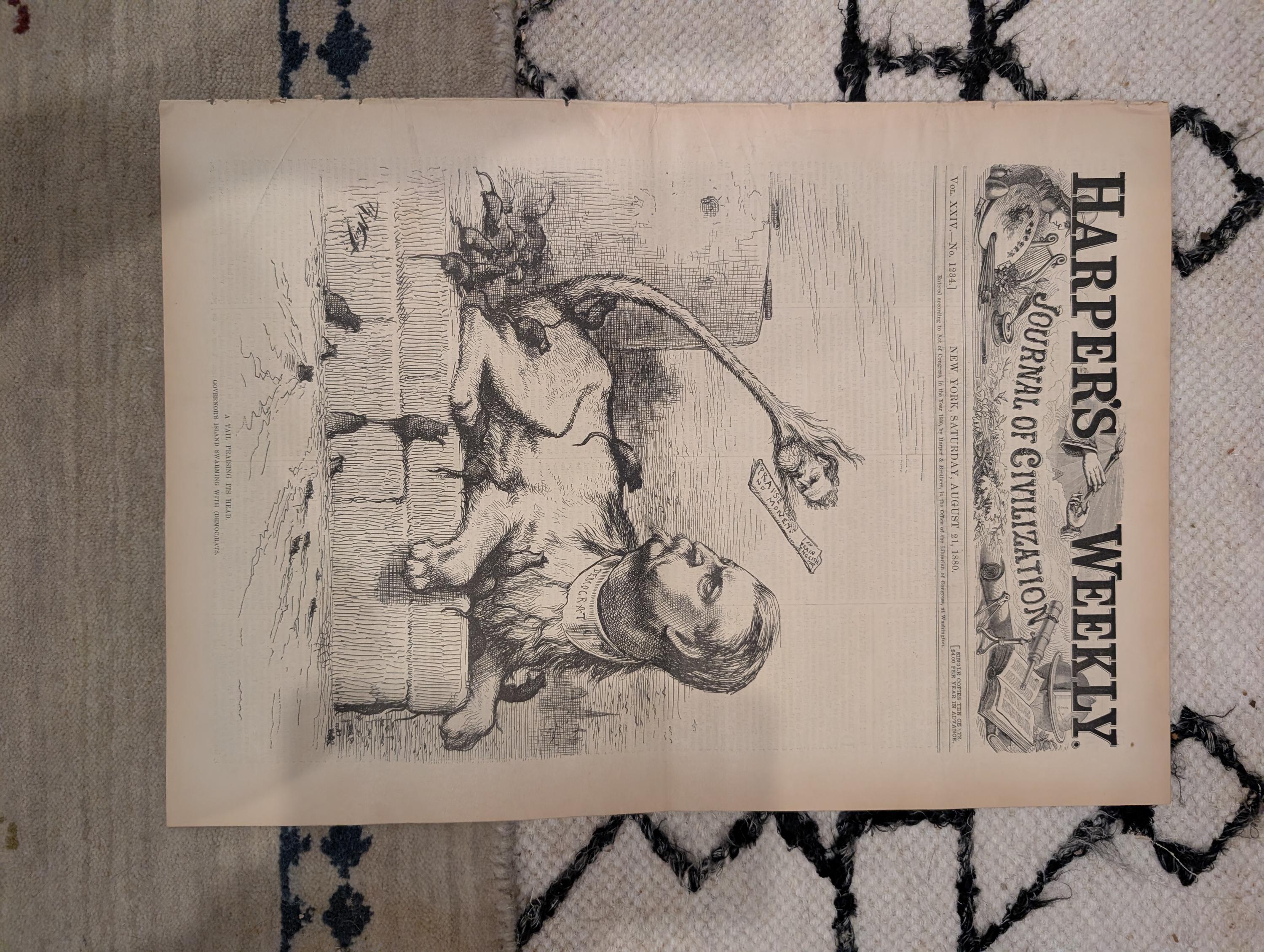
🎨 FULL FRONT PAGE — THOMAS NAST: "A TAIL PRAISING ITS HEAD"
Thomas Nast opens the issue with a front-page political cartoon of satirical anatomical precision — "A Tail Praising Its Head" inverting the natural order of political authority to make a pointed argument about which part of the Democratic coalition was actually in control of the enterprise. In the summer of 1880, the question of whether Hancock was leading his party or being led by it — whether the head was directing the tail or the tail wagging the head — was one of the central and most damaging lines of Republican attack. Nast's cartoon makes that argument with characteristic visual economy and devastating effect. A fully displayable and historically precise front page for collectors of Nast's work and the 1880 presidential election.
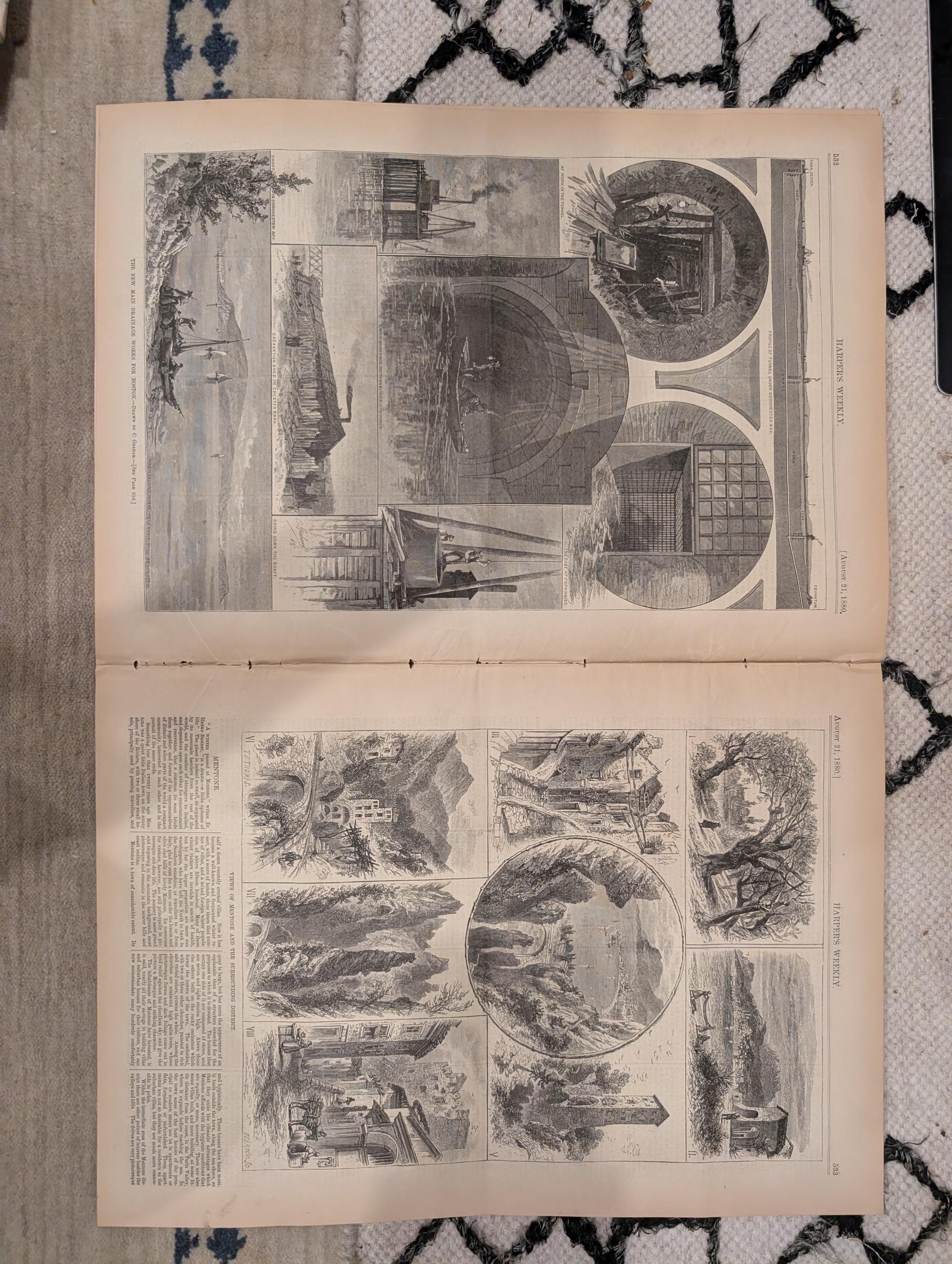
🚰 FULL PAGE — "NEW MAIN DRAINAGE WORKS FOR BOSTON" — EIGHT SCENES
A magnificent and historically significant full-page documentary of Boston's new main drainage system — eight scenes capturing one of the great Victorian public health engineering projects in American history. Boston's drainage crisis had been building for decades — the city's rapid growth had overwhelmed its original sewage infrastructure, and the resulting contamination of the harbor and the surrounding waters was a public health catastrophe of the first order. The new main drainage works — an ambitious system of intercepting sewers, pumping stations, and outfall channels designed to carry Boston's waste far out into Massachusetts Bay — represented the most advanced thinking in sanitary engineering of the age, and its construction was one of the great infrastructure stories of 1880. Eight scenes document the project with the technical thoroughness and documentary ambition that Harper's Weekly brought to its finest engineering coverage. A primary source document for collectors of Boston history, public health history, Victorian sanitary engineering, and the history of American urban infrastructure.
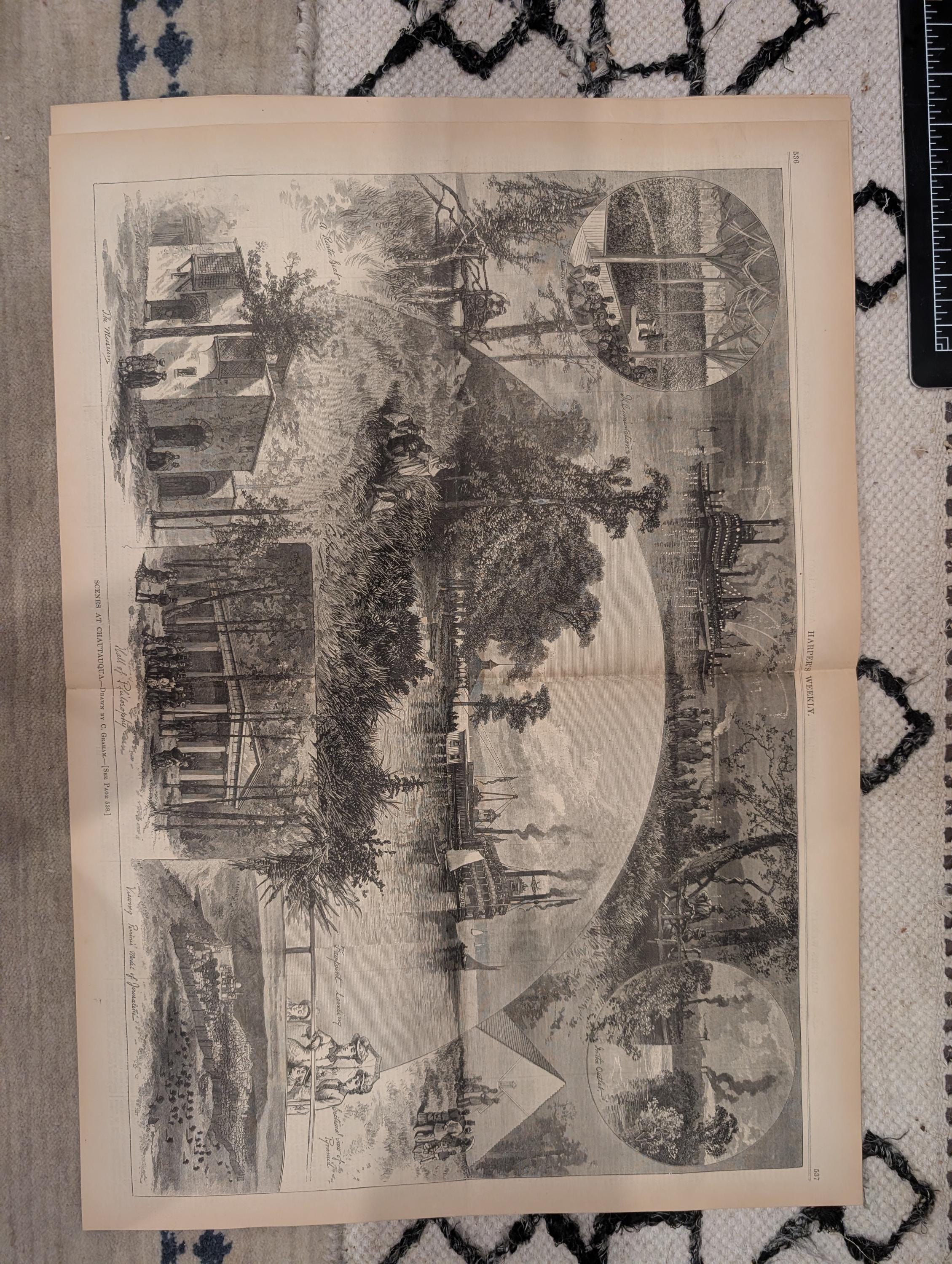
🌊 DOUBLE-PAGE CENTERFOLD — "SCENES AT CHAUTAUQUA" — NINE SCENES
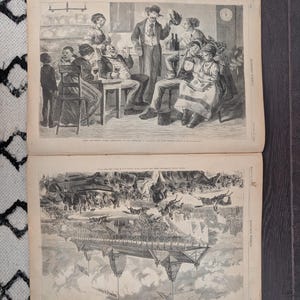
The visual crown jewel of this issue — a magnificent double-page centerfold of nine scenes at the Chautauqua Institution on the shores of Lake Chautauqua in western New York, one of the most remarkable and consequential cultural experiments in American history. The Chautauqua Institution had been founded in 1874 by Methodist minister John Heyl Vincent and manufacturer Lewis Miller as a summer training program for Sunday school teachers, and had rapidly evolved into something far more ambitious — a summer assembly that offered lectures, concerts, religious services, and educational programs to thousands of middle-class Americans who arrived each year to spend weeks in an atmosphere of intellectual and spiritual improvement unlike anything else in the country. By 1880 Chautauqua had become a genuine American phenomenon — the model for hundreds of similar assemblies that would eventually spread across the country as the Chautauqua movement, bringing culture, education, and enlightenment to communities far from the great cities and their institutions.
Nine scenes across a double-page spread capture the full texture of the Chautauqua experience — the lakeside setting, the assembly grounds, the lecture halls and amphitheater, the crowds of earnest middle-class Americans pursuing self-improvement in the summer air of western New York. For collectors of American educational history, the history of adult education, the history of the Chautauqua movement, and Gilded Age cultural history, this centerfold is a primary source document of exceptional importance and beauty. What was Chautauqua? It was the American democratic faith in self-improvement made physical — a place, a season, a community of people who believed that everyone deserved access to the life of the mind. Here it is, nine scenes, in its earliest and most idealistic years.
🌊 THREE-QUARTER PAGE — "VIEW OF MENTONE AND THE SURROUNDING DISTRICT" — EIGHT SCENES
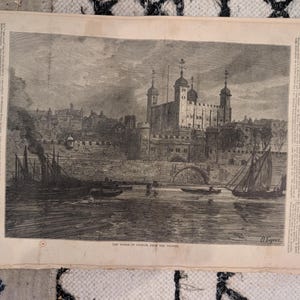
A richly atmospheric three-quarter page of eight views of Mentone — the sun-drenched resort town on the French Riviera, sheltered between the Maritime Alps and the Mediterranean, that had become one of the most fashionable wintering destinations in Europe for the British and American wealthy. Mentone — now Menton — sits at the very eastern edge of France, just miles from the Italian border, its lemon groves and olive terraces climbing the steep hillsides above a harbor of almost impossible blue. Queen Victoria, the Russian aristocracy, and the English upper classes had made it their winter retreat, and by 1880 it was firmly established as one of the great pleasure grounds of the European world. These eight scenes — the harbor, the promenade, the old town, the surrounding Alpine landscape — constitute a vivid and beautiful documentary portrait of one of the Mediterranean's most beloved destinations at its Victorian peak. A wonderful piece for collectors of French Riviera history and Victorian travel illustration.
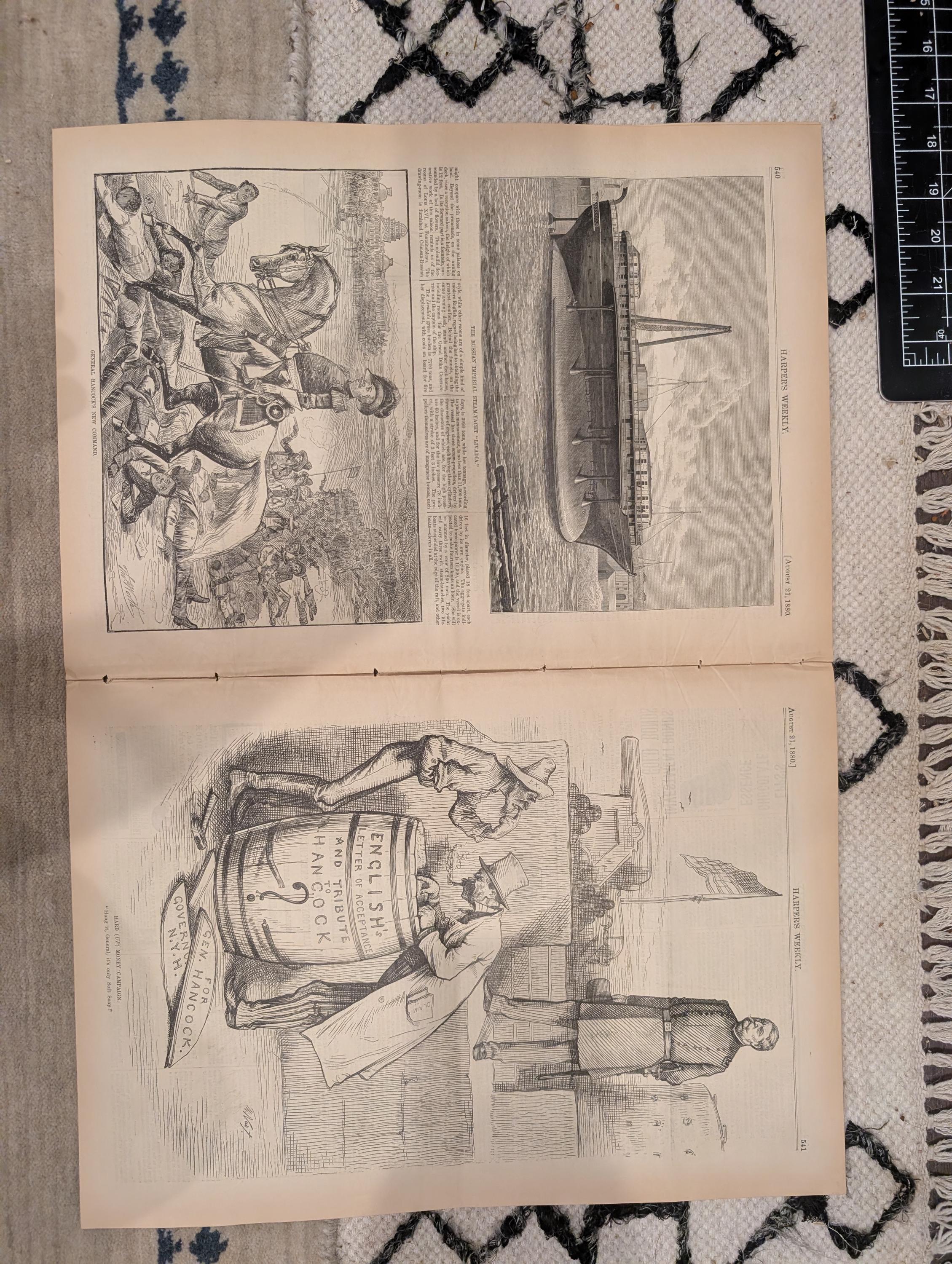
🎨 FULL PAGE — THOMAS NAST: "HARD (UP) MONEY CAMPAIGN"
The second Thomas Nast full-page political cartoon of the issue engages with one of the most technically complex and politically charged issues of the 1880 campaign — the money question. "Hard (Up) Money Campaign" plays on the dual meaning of "hard up" — the financial slang for being broke — to make an argument about the Democratic Party's monetary contradictions. Hancock had tried to avoid the currency issue entirely, famously declaring it "a local question" in one of the most memorably evasive answers in American political history. Nast's cartoon skewers that evasion — the hard money campaign that was also a "hard up" campaign, short of both ideas and credibility on the central economic question of the age. A significant Nast full page for collectors of his work, the money question in Gilded Age politics, and the 1880 presidential election.
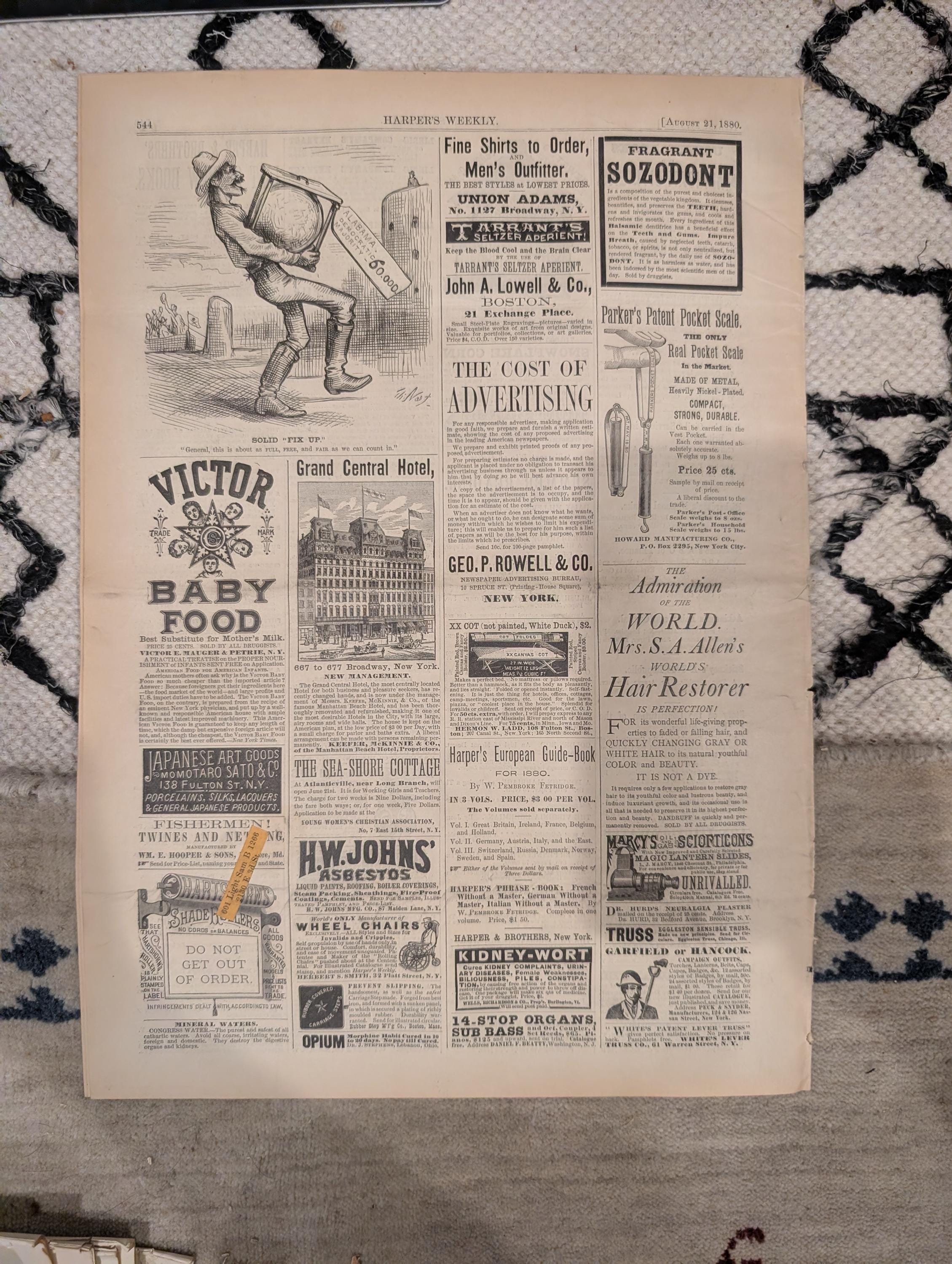
🎨 THOMAS NAST CARTOON — "SOLID FIX UP"
A third Thomas Nast cartoon — "Solid Fix Up" — adds to what is one of the strongest Nast issues of the entire summer run. Three Thomas Nast illustrations in a single issue is an exceptional find for collectors of his work, and this trio — "A Tail Praising Its Head," "Hard (Up) Money Campaign," and "Solid Fix Up" — shows Nast working the 1880 campaign from multiple angles simultaneously, his pen never resting in the crucial months before the November election.
📝 PAGE 531 — WALT WHITMAN NOTE
Tucked into the text of page 531 — not illustrated, not headlined, but present and remarkable — is a note about Walt Whitman: that the great poet had been seriously ill at a friend's house in Canada, and had recovered sufficient strength to resume his travels. In August 1880 Walt Whitman was 61 years old, still recovering from the stroke he had suffered in 1873, and spending part of the summer in Canada visiting his friend Dr. Richard Maurice Bucke in London, Ontario. The note is brief — a few lines in the miscellaneous column — but it is a primary source document of Whitman's life at a specific moment, the kind of contemporary record that literary historians and collectors of Americana prize precisely because it captures the poet not as a monument but as a living man, ill and then recovering, resuming his travels in the summer of 1880. For collectors of Walt Whitman history and American literary history, this page 531 note is a genuine find hiding in plain sight inside a summer Harper's Weekly.
🔍 CONDITION & TRANSPARENCY 🔍
Completeness: Complete 16-page issue.
Authenticity: Guaranteed original printing from August 21, 1880 — not a reproduction.
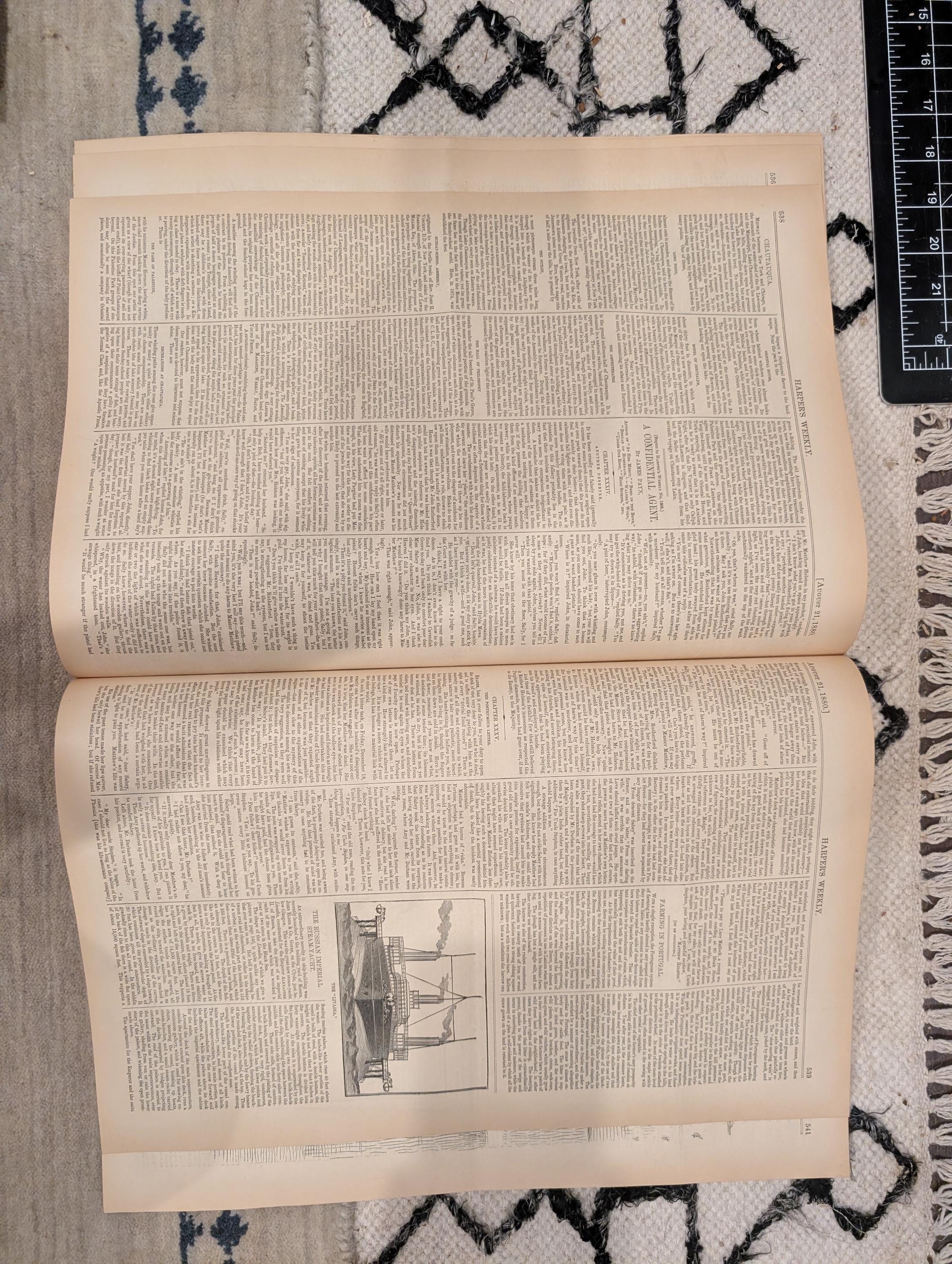
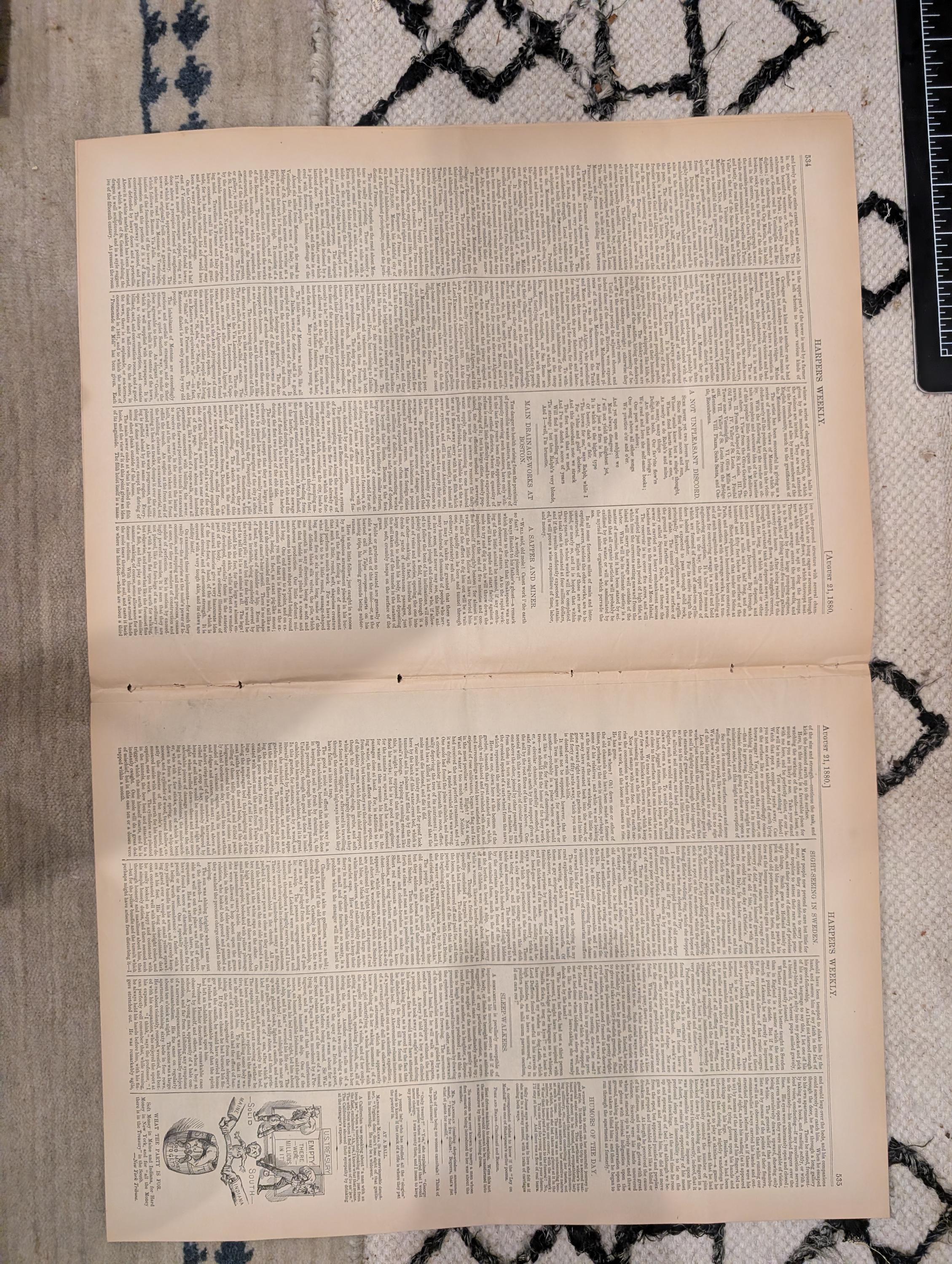
Condition Report: Presents well for its 145-year age with natural toning to the newsprint consistent with paper of this era. The Thomas Nast front page, the Boston drainage full page, the Chautauqua double-page centerfold, the Mentone eight-scene three-quarter page, the second Nast full page, and all additional Nast cartoons are clear and displayable. The Walt Whitman note on page 531 is present and legible. I have photographed every page — please review all images carefully and don't hesitate to ask for additional close-ups of any area before purchasing.
📦 SHIPPING & PRESERVATION 📦
Housed in an acid-free archival folder with Mylar overlay to protect the 145-year-old newsprint
Flat-shipped with heavy-duty reinforcement to ensure safe arrival of the centerfold
Fully tracked for your peace of mind
In August 1880 thousands of Americans were improving their minds at Chautauqua, Boston was burying its sewage problems underground, Walt Whitman was recovering from illness in Canada, and Thomas Nast was watching the election from three different angles in the same issue. What a paper. What a summer.
🏷️ TAGS
1880 Chautauqua Institution Nine Scenes, Chautauqua Movement History, Boston Main Drainage Works, Victorian Sanitary Engineering Boston, Mentone French Riviera Victorian, Thomas Nast Three Cartoons, Walt Whitman 1880 Note Primary Source, Nast Hard Money Campaign, Nast Tail Praising Head, Nast Solid Fix Up, Gilded Age Adult Education, Chautauqua Lake New York, French Riviera Victorian Travel, Antique Newspaper 1880, Harper's Weekly 1880, Walt Whitman Literary History -
Shipping & Policies
Related Products